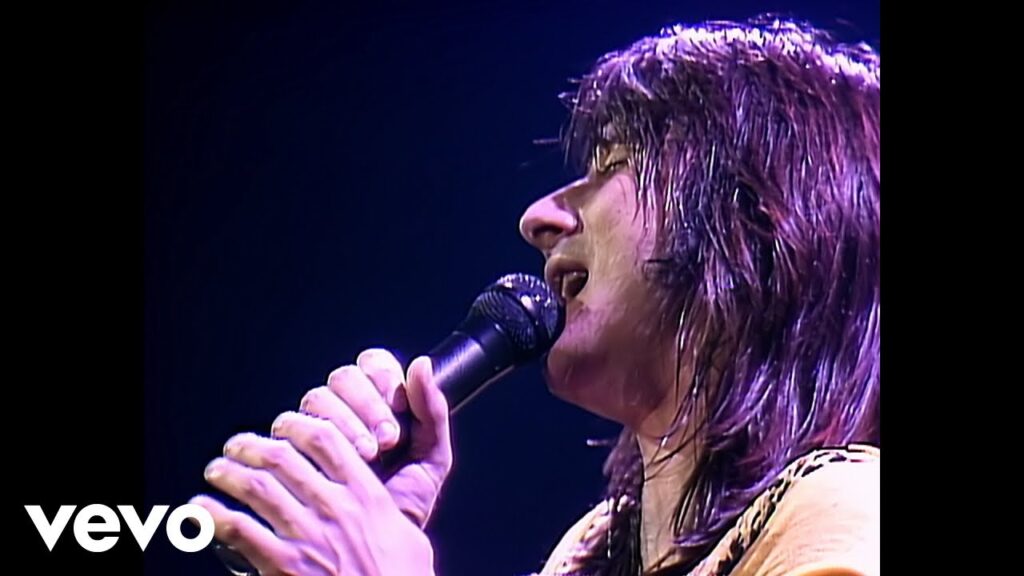
Long before power ballads dominated rock radio, Journey had already mastered the art of combining soaring melodies with heartfelt storytelling. While the band was capable of delivering explosive arena rockers, some of its most memorable moments came when emotion took center stage. “Who’s Crying Now,” released in 1981 as the lead single from Escape, perfectly captured that balance. With Steve Perry’s passionate vocal performance, Jonathan Cain’s elegant keyboards, and Neal Schon’s unforgettable guitar solo, the song became one of Journey’s defining hits and helped launch one of the greatest rock albums ever recorded.
Unlike many breakup songs that lean heavily on anger or heartbreak, “Who’s Crying Now” takes a more reflective approach. It explores the ups and downs of relationships with maturity and optimism, suggesting that even difficult moments can strengthen the bonds between two people. More than four decades after its release, the song continues to resonate with listeners because of its emotional honesty, timeless melody, and exceptional musicianship.
Journey entered the 1980s already riding a wave of success. Steve Perry’s arrival in 1977 had transformed the band’s sound, adding a soulful, melodic dimension that broadened its audience. Albums like Infinity, Evolution, and Departure produced several successful singles and established Journey as one of America’s premier rock bands.
A significant change came in 1980 when keyboardist Jonathan Cain joined the group, replacing Gregg Rolie. Cain had previously played with The Babys and brought not only impressive keyboard skills but also a gift for songwriting. His partnership with Steve Perry quickly became one of the band’s greatest creative strengths.
“Who’s Crying Now” was among the first songs written by Perry and Cain together. Their chemistry was immediately apparent, blending Perry’s emotional instincts with Cain’s sophisticated melodies to create a song that showcased the band’s evolving sound.
The recording would become the perfect introduction to Escape, an album packed with future classics including “Don’t Stop Believin’,” “Open Arms,” “Stone in Love,” and “Still They Ride.”
From its opening piano chords, “Who’s Crying Now” establishes a mood of quiet reflection. Jonathan Cain’s keyboard work provides a warm and inviting foundation before Ross Valory’s melodic bass and Steve Smith’s tasteful drumming gradually build the arrangement.
Producer Kevin Elson crafted a recording that balances intimacy with arena-sized grandeur. Rather than overwhelming the listener with layers of instrumentation, the production allows each musical element room to breathe. The verses remain restrained, creating anticipation for the powerful chorus that follows.
Neal Schon’s guitar work deserves special recognition. Throughout the song, he resists the temptation to dominate the arrangement with flashy riffs, instead contributing tasteful fills that complement the vocals. His extended solo near the end of the recording is widely regarded as one of the finest of his career. Combining technical brilliance with melodic sensitivity, the solo serves as an emotional continuation of the song rather than a showcase of virtuosity.
The production also highlights Journey’s remarkable rhythm section. Steve Smith’s drumming is precise and dynamic, while Ross Valory’s bass provides subtle melodic movement that enriches the harmonic structure without drawing attention away from the song itself.
Steve Perry delivers one of the most emotionally compelling performances of his career. Often referred to as “The Voice” because of his extraordinary range and expressive style, Perry demonstrates remarkable control throughout the recording. He begins with quiet vulnerability before gradually building toward the soaring choruses that became one of Journey’s trademarks.
What makes Perry’s performance particularly effective is its sincerity. He never sounds as though he’s simply showing off his vocal ability. Every note serves the emotional narrative, allowing listeners to feel the uncertainty, hope, and resilience expressed by the song.
His phrasing is equally impressive. Perry knows exactly when to pull back and when to unleash his powerful upper register, creating dramatic contrast that keeps the listener engaged from beginning to end.
Journey’s trademark harmony vocals further elevate the recording. Carefully layered backing vocals enrich the chorus without overwhelming Perry’s lead, creating a sound that is both expansive and deeply personal.
Lyrically, “Who’s Crying Now” examines the emotional cycles that occur within romantic relationships. Rather than portraying conflict as a sign of failure, the song acknowledges that disagreements and misunderstandings are natural parts of love. The narrator suggests that reconciliation is possible if both people remain committed to one another.
This mature perspective distinguishes the song from many relationship ballads of its era. Instead of focusing on blame or despair, it emphasizes understanding, forgiveness, and emotional growth. Those universal themes continue to resonate because nearly everyone has experienced moments when love requires patience and perseverance.
The lyrics also leave enough room for personal interpretation. Whether listeners relate the song to romance, family, friendship, or other important relationships, its emotional message remains meaningful and accessible.
Released in July 1981, “Who’s Crying Now” became Journey’s first Top 10 hit on the Billboard Hot 100, reaching No. 4. The song also performed strongly on rock and adult contemporary radio, introducing the Escape album to an enormous audience.
Its success set the stage for one of the most remarkable album campaigns in rock history. Escape eventually reached No. 1 on the Billboard 200 and sold millions of copies worldwide, becoming Journey’s most successful studio album. The record produced multiple enduring classics and firmly established the band as one of the biggest rock acts in the world.
The music video, featuring the band performing in a straightforward concert-style setting, received regular exposure during MTV’s earliest years. Although released before elaborate music videos became the norm, it helped introduce Journey to a growing television audience and reinforced the band’s reputation as exceptional live performers.
Over the decades, “Who’s Crying Now” has remained a staple of classic rock radio and one of the highlights of Journey’s concerts. Fans continue to respond enthusiastically to its soaring chorus and emotional guitar solo, often singing along from the opening verse to the final note.
The song also helped define the melodic rock style that influenced countless bands throughout the 1980s. Its blend of polished production, heartfelt lyrics, exceptional musicianship, and memorable hooks became a blueprint for many arena rock acts that followed.
Today, “Who’s Crying Now” stands as one of Journey’s finest achievements. It captures everything that made the band special: Steve Perry’s extraordinary voice, Jonathan Cain’s elegant songwriting, Neal Schon’s expressive guitar playing, and a rhythm section that provided both power and subtlety.
More than forty years after its release, the song continues to connect with listeners because it speaks honestly about the challenges and rewards of love. It reminds us that relationships are rarely perfect, but they are often worth the effort required to make them last. Through beautiful melodies, outstanding performances, and timeless songwriting, Journey created a classic that remains every bit as moving today as it was in 1981.
This post has already been read 70 times!