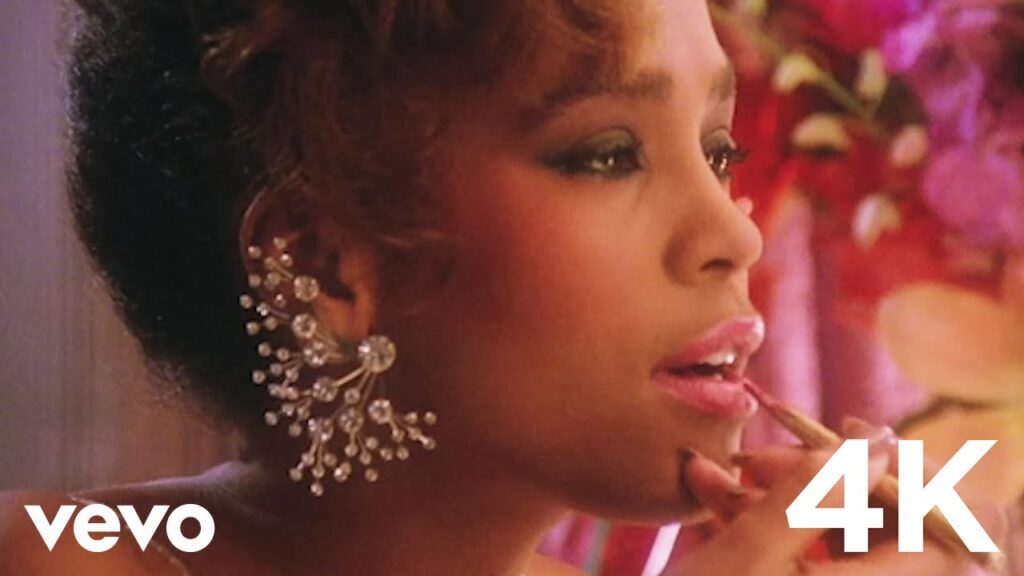
Released in 1986 as the third single from her self-titled debut album, “Greatest Love of All” became one of Whitney Houston’s defining performances and one of the most inspirational songs ever recorded. Although the song was originally written by Michael Masser and Linda Creed for the 1977 Muhammad Ali film The Greatest, with George Benson recording the original version, it was Whitney Houston’s breathtaking interpretation that transformed it into a global anthem of hope, self-worth, and perseverance.
By the time the single was released, Houston was already emerging as one of the most exciting new voices in popular music. “Saving All My Love for You” and “How Will I Know” had established her as a major star, but “Greatest Love of All” demonstrated something even more important—it proved she possessed a once-in-a-generation vocal talent capable of elevating great material into something truly unforgettable.
Today, the song remains one of the cornerstones of Whitney Houston’s extraordinary legacy.
Song Overview
“Greatest Love of All” centers on the importance of believing in yourself and finding strength from within. Rather than focusing on romance or heartbreak, the song encourages listeners to develop confidence, dignity, and self-respect.
Its message is both personal and universal.
Whether someone is overcoming adversity, chasing a dream, or simply searching for reassurance, the lyrics offer encouragement without feeling overly sentimental.
That timeless message has allowed the song to resonate across generations.
It continues to be performed at graduations, talent competitions, inspirational events, and celebrations around the world.
Songwriting
Written by Michael Masser and Linda Creed, “Greatest Love of All” is beautifully structured from beginning to end.
The verses gradually build emotional anticipation before opening into one of the most powerful choruses ever written. The melody provides enormous opportunities for vocal expression while remaining memorable enough for audiences to sing along.
Linda Creed’s lyrics are especially moving because they avoid clichés in favor of sincere optimism. The song speaks directly to listeners without becoming preachy or overly complicated.
Every line contributes to the central theme of self-belief.
It’s inspirational songwriting at its finest.
Performance
Whitney Houston delivers one of the greatest vocal performances in pop music history.
From the opening notes, she demonstrates remarkable control and emotional sensitivity. Rather than immediately showcasing her extraordinary range, she begins with quiet confidence, allowing the performance to grow naturally.
As the song progresses, Houston unleashes the full power of her voice.
Her effortless transitions, flawless phrasing, soaring high notes, and impeccable breath control create a performance that few singers could hope to match.
Perhaps most impressive is her ability to balance technical brilliance with genuine emotion.
Every note serves the song rather than simply displaying vocal ability.
It is a masterclass in vocal performance.
Production
Produced by Michael Masser, the recording embraces lush orchestration while allowing Houston’s voice to remain the unquestioned centerpiece.
The arrangement features elegant piano, sweeping strings, tasteful synthesizers, restrained percussion, and subtle backing vocals that gradually expand alongside the lead vocal.
Nothing feels excessive.
The production understands that the greatest instrument in the room is Whitney Houston herself.
Even today, the recording sounds polished and timeless because it prioritizes musicianship and vocal excellence over temporary studio trends.
Standout Moments
Several elements elevate “Greatest Love of All” into legendary status:
- Whitney Houston’s extraordinary vocal performance.
- An unforgettable inspirational message.
- Beautiful songwriting by Michael Masser and Linda Creed.
- Elegant orchestral production.
- One of the most emotionally satisfying climaxes in popular music.
The final chorus remains one of the defining vocal moments of the 1980s.
Every performance leading up to it builds toward a breathtaking emotional payoff.
Weak Points
There are remarkably few criticisms to make.
Some listeners who prefer understated performances may find the dramatic vocal climax somewhat grand compared to more intimate ballads.
Others may feel the polished adult contemporary production firmly reflects mid-1980s recording styles.
However, neither observation diminishes the song’s effectiveness.
Its grandeur is precisely what allows the inspirational message to resonate so powerfully.
Legacy
“Greatest Love of All” became Whitney Houston’s third consecutive No. 1 single on the Billboard Hot 100, helping establish her debut album as one of the most successful first albums in music history.
The song earned worldwide acclaim and became one of Houston’s signature performances throughout her career. It also cemented her reputation as perhaps the greatest vocalist of her generation, influencing countless singers who followed.
Over the decades, “Greatest Love of All” has become much more than a hit single. It has been embraced as an anthem of confidence, resilience, and personal growth, appearing at graduations, award ceremonies, charity events, and countless occasions celebrating achievement and perseverance.
Few songs have maintained such widespread emotional significance across multiple generations.
Final Score
10/10
“Greatest Love of All” is one of the greatest vocal performances ever committed to record. Whitney Houston transforms an already exceptional composition into something transcendent through flawless technique, extraordinary emotional depth, and unmatched vocal power. Combined with elegant production and a timeless message of self-belief, the song stands as one of the defining recordings of the 1980s and one of the most inspirational pop songs ever made. It is not only a highlight of Whitney Houston’s legendary career—it is one of the finest performances in the history of popular music.
This post has already been read 82 times!