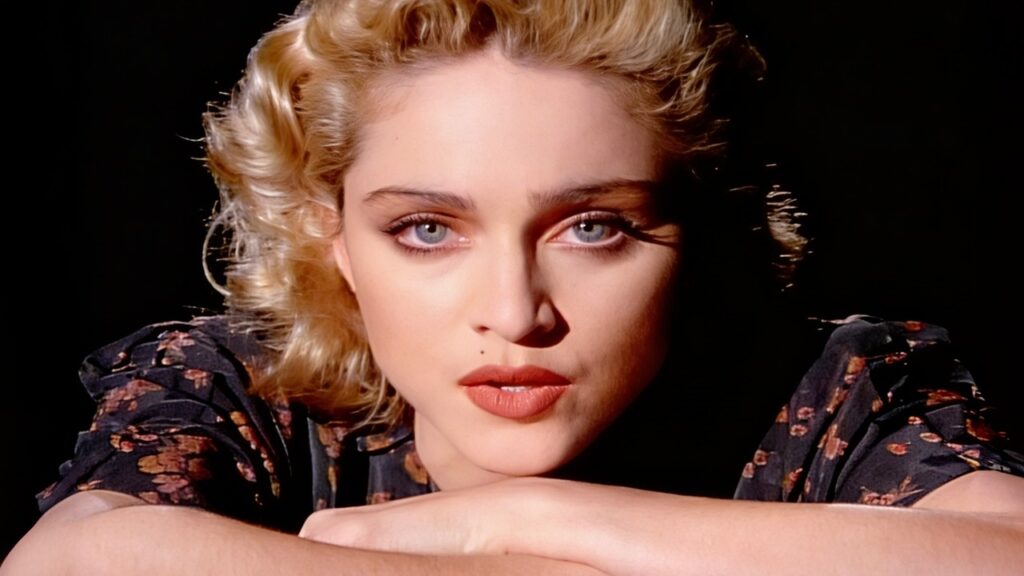
By the middle of the 1980s, Madonna had already become one of the biggest names in music. Hits like “Holiday,” “Like a Virgin,” “Material Girl,” and “Into the Groove” had made her the face of modern pop, with an image built around dance music, fashion, and constant reinvention. Critics often questioned whether her success was driven more by style than substance.
Then came “Live to Tell.”
Released in 1986, the haunting ballad surprised nearly everyone. Instead of pounding drums and infectious dance beats, listeners were greeted by sparse instrumentation, a deeply emotional vocal performance, and one of the most mature songs Madonna had ever recorded. It revealed a side of the singer that many had overlooked and became one of the defining moments of her career.
Nearly forty years later, “Live to Tell” remains one of Madonna’s finest recordings, proving that beneath the headlines and controversy was an artist capable of remarkable emotional depth.
A New Direction
“Live to Tell” served as the lead single from Madonna’s third studio album, True Blue. It also appeared prominently in the film At Close Range, starring Sean Penn and Christopher Walken.
The movie’s themes of betrayal, trust, and family conflict fit perfectly with the song’s reflective mood. Although the lyrics are intentionally open to interpretation, they complement the film’s emotional landscape without depending on it.
For Madonna, it represented a dramatic shift away from the upbeat dance-pop that had defined her first two albums.
It was a gamble.
It paid off spectacularly.
A Song Built on Atmosphere
From its opening notes, “Live to Tell” creates an entirely different emotional space than most of Madonna’s earlier work.
Gentle synthesizers, understated keyboards, soft percussion, and subtle guitar textures leave plenty of room for the vocals.
The arrangement is remarkably restrained.
Instead of building toward an explosive climax, the music gradually unfolds, allowing every lyric to carry additional weight.
Producer Patrick Leonard deserves enormous credit for crafting a sound that feels cinematic without becoming overly dramatic. Every instrument serves the emotion of the song rather than trying to dominate it.
The result is timeless.
Madonna’s Most Vulnerable Vocal
Perhaps the biggest surprise for listeners in 1986 was Madonna’s singing.
Rather than emphasizing attitude or playful confidence, she delivers the performance with remarkable vulnerability.
Her voice remains controlled throughout, but there is unmistakable emotion behind every phrase. She never oversings the material, allowing quiet moments to become just as powerful as the larger ones.
The performance demonstrated how much she had grown as a vocalist since her debut only a few years earlier.
It also silenced many critics who questioned whether she could handle more serious material.
Lyrics Open to Interpretation
One reason “Live to Tell” has endured is its lyrical ambiguity.
The song explores themes of trust, secrecy, survival, disappointment, and emotional healing without spelling out a specific story.
Listeners have connected it to broken relationships, family struggles, personal loss, childhood trauma, friendship, and countless other life experiences.
Because the song never forces one interpretation, it becomes deeply personal for each listener.
That’s one of the hallmarks of exceptional songwriting.
A Major Commercial Success
Released in the spring of 1986, “Live to Tell” quickly climbed the charts.
It became Madonna’s first major power ballad and reached No. 1 on the Billboard Hot 100 in the United States. It also enjoyed significant international success, reaching the Top 10 in numerous countries and helping build anticipation for the release of True Blue.
The song demonstrated that Madonna could dominate the charts without relying on dance-floor energy or provocative imagery.
She could simply let the music speak for itself.
The Perfect Introduction to True Blue
True Blue would eventually become one of the biggest albums of Madonna’s career, producing an incredible run of hit singles including “Papa Don’t Preach,” “Open Your Heart,” “True Blue,” and “La Isla Bonita.”
“Live to Tell” set the tone perfectly.
It announced that Madonna was entering a more mature phase both musically and personally.
Rather than abandoning pop, she expanded what audiences expected from her.
The album became one of the defining releases of 1986.
The Music Video
The video mirrors the understated elegance of the song.
Instead of elaborate choreography or theatrical concepts, it primarily features scenes of Madonna performing alongside footage connected to At Close Range.
The restrained visuals allow viewers to focus on the emotion of the music.
In an era when flashy music videos often competed for attention, the simplicity of “Live to Tell” felt refreshingly confident.
A Favorite in Concert
Although Madonna is known for spectacular live productions filled with dancers, elaborate costumes, and visual effects, “Live to Tell” has often provided one of the emotional high points of her concerts.
Its quiet intimacy creates a striking contrast with her more energetic performances.
Over the years, she has reimagined the song several times in live settings, using it to address themes of remembrance, loss, and resilience.
Those performances have reinforced the song’s lasting emotional significance.
Why It Still Resonates
Many ballads lose their impact because they’re tied too closely to the production trends of their era.
“Live to Tell” avoids that problem.
Its sparse arrangement, thoughtful pacing, and emotional honesty allow it to age gracefully.
The recording feels neither dated nor overly polished.
Instead, it possesses a timeless quality that continues to attract new listeners decades after its release.
Whether heard through headphones late at night or on a classic hits station during a drive, the song still has the ability to stop listeners in their tracks.
Madonna’s Artistic Evolution
Looking back, “Live to Tell” marked a turning point.
It showed that Madonna wasn’t content being viewed simply as a pop phenomenon.
She wanted to challenge herself creatively.
That willingness to evolve would become one of the defining characteristics of her career. Throughout the following decades she would continue experimenting with new sounds, visual styles, producers, and musical genres, but “Live to Tell” was among the earliest examples of her artistic ambition taking center stage.
It helped transform public perception from pop star to serious recording artist.
Final Thoughts
Every great artist has a song that changes how audiences see them.
For Madonna, “Live to Tell” was one of those songs.
It traded flashy production for quiet confidence, replaced playful flirtation with emotional honesty, and showcased a vocal performance that remains among the finest of her career. The combination of thoughtful songwriting, elegant production, and heartfelt delivery created a ballad that has endured long after many of its contemporaries faded from memory.
Today, “Live to Tell” stands not only as one of Madonna’s greatest recordings but also as one of the finest pop ballads of the 1980s. It serves as a reminder that sometimes the most powerful statement an artist can make isn’t the loudest one—it’s the one whispered with sincerity and conviction.
This post has already been read 75 times!