Some songs are beautiful. Others are dramatic. “Total Eclipse of the Heart” by Bonnie Tyler is both, delivering an emotional experience so grand that it has become one of the defining power ballads of all time. Released in 1983 as the lead single from the album Faster Than the Speed of Night, the song transformed Tyler into an international superstar and gave the world one of the most unforgettable recordings of the decade.
Built around soaring melodies, cinematic production, and Tyler’s unmistakable raspy voice, “Total Eclipse of the Heart” became a global phenomenon. It topped charts in numerous countries, sold millions of copies, and has remained a fixture on radio stations, streaming playlists, and karaoke stages for more than forty years.
Its enormous popularity isn’t simply the result of a memorable chorus. The song succeeds because every element—from its songwriting to its production—works together to create an emotional journey unlike almost anything else in pop music.
Jim Steinman’s Theatrical Vision
The creative force behind “Total Eclipse of the Heart” was legendary songwriter and producer Jim Steinman.
Already famous for writing larger-than-life songs for Meat Loaf, Steinman specialized in music that felt cinematic, emotional, and unapologetically dramatic. He approached songwriting almost like writing scenes for a movie, filling his compositions with sweeping melodies and powerful emotional arcs.
Originally, Steinman conceived “Total Eclipse of the Heart” as part of a musical project inspired by classic gothic themes. While the song eventually found a different home, traces of that theatrical vision remained throughout the finished recording.
The result feels less like a conventional pop song and more like a five-minute emotional epic.
Bonnie Tyler’s Extraordinary Voice
Very few singers could have delivered this song successfully.
Bonnie Tyler possessed exactly the right instrument.
Her naturally raspy voice gives every lyric a sense of urgency and vulnerability that a smoother vocalist might never have achieved. She balances raw emotion with remarkable control, gradually increasing the intensity as the arrangement grows larger.
By the final chorus, Tyler sounds as though she’s pouring every ounce of emotion into the performance.
Yet she never loses clarity.
Every word lands with tremendous impact.
It’s one of the finest vocal performances of the 1980s.
A Song That Never Stops Building
One reason “Total Eclipse of the Heart” remains so compelling is its remarkable structure.
Rather than reaching its emotional peak immediately, the song builds patiently.
Each verse adds another layer.
Each chorus raises the stakes.
The instrumentation grows richer.
The harmonies become bigger.
The drama intensifies.
By the time the climactic final section arrives, listeners have been taken on an emotional journey that feels completely earned.
It’s a masterclass in musical storytelling.
Production on a Cinematic Scale
Jim Steinman’s production embraces grandeur without becoming chaotic.
Towering piano chords establish the emotional foundation before guitars, drums, synthesizers, and orchestral textures gradually expand the sound.
Every instrument contributes to the growing sense of drama.
The backing vocals add tremendous emotional weight, surrounding Tyler’s lead vocal without ever overpowering it.
Even at its loudest moments, the recording remains remarkably balanced.
Few songs from the era sound this enormous while maintaining such clarity.
Lyrics That Invite Personal Interpretation
Although many listeners associate the song with heartbreak, “Total Eclipse of the Heart” never limits itself to one specific story.
Its lyrics explore themes of longing, emotional distance, loss, and hope, but they remain open enough for listeners to apply their own experiences.
Some hear the end of a relationship.
Others hear loneliness.
Some simply connect with the overwhelming emotional intensity.
That ambiguity has helped the song remain relevant across generations.
The best songs rarely dictate exactly what they mean.
They invite listeners to find their own meaning.
A Worldwide Smash Hit
Upon its release, “Total Eclipse of the Heart” became one of the biggest singles of 1983.
It reached No. 1 on the Billboard Hot 100 and topped charts throughout Europe, Australia, Canada, and many other countries.
The song propelled Faster Than the Speed of Night to international success and firmly established Bonnie Tyler as one of the decade’s biggest recording artists.
It also earned Grammy nominations and widespread critical acclaim, becoming the defining song of Tyler’s remarkable career.
Some artists spend decades searching for one signature hit.
Bonnie Tyler found hers.
An Unforgettable Music Video
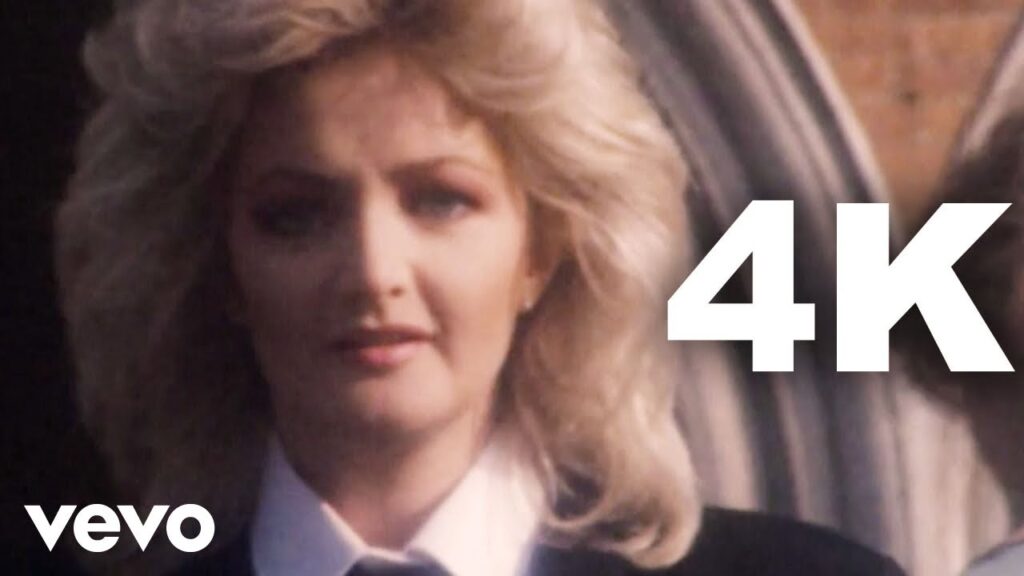
The music video for “Total Eclipse of the Heart” became nearly as iconic as the song itself.
Filled with surreal imagery, dramatic lighting, and dreamlike symbolism, it perfectly matched the theatrical nature of the music.
Rather than telling a straightforward story, the video embraced mystery and emotion, creating visuals that audiences remembered long after the song ended.
Heavy MTV rotation helped introduce Bonnie Tyler to millions of viewers worldwide, making the song an essential part of the early music video era.
Its visual style remains unmistakably linked to the grand ambitions of 1980s pop.
A Legacy That Continues to Grow
Few power ballads have enjoyed the lasting popularity of “Total Eclipse of the Heart.”
It continues to appear in films, television shows, sporting events, commercials, and countless karaoke performances.
The song has also inspired numerous cover versions across genres ranging from pop and rock to classical and musical theater.
Each new generation seems to rediscover its emotional power.
Very few recordings maintain that level of cultural relevance for more than four decades.
Final Thoughts
“Total Eclipse of the Heart” remains one of the greatest power ballads ever recorded because it embraces emotion without hesitation. Jim Steinman’s extraordinary songwriting and cinematic production, combined with Bonnie Tyler’s unforgettable vocal performance, created a song that feels larger than life while remaining deeply personal.
Its massive commercial success made it one of the defining hits of the 1980s, but its true achievement lies in its ability to move listeners year after year. Every soaring chorus, every dramatic piano chord, and every passionate vocal phrase contributes to an experience that still feels exhilarating decades after its release.
Many love songs fade with time.
“Total Eclipse of the Heart” has only grown more powerful.
It stands as a towering achievement in popular music—a breathtaking reminder that when exceptional songwriting meets the perfect voice, the result can become truly timeless.
This post has already been read 84 times!