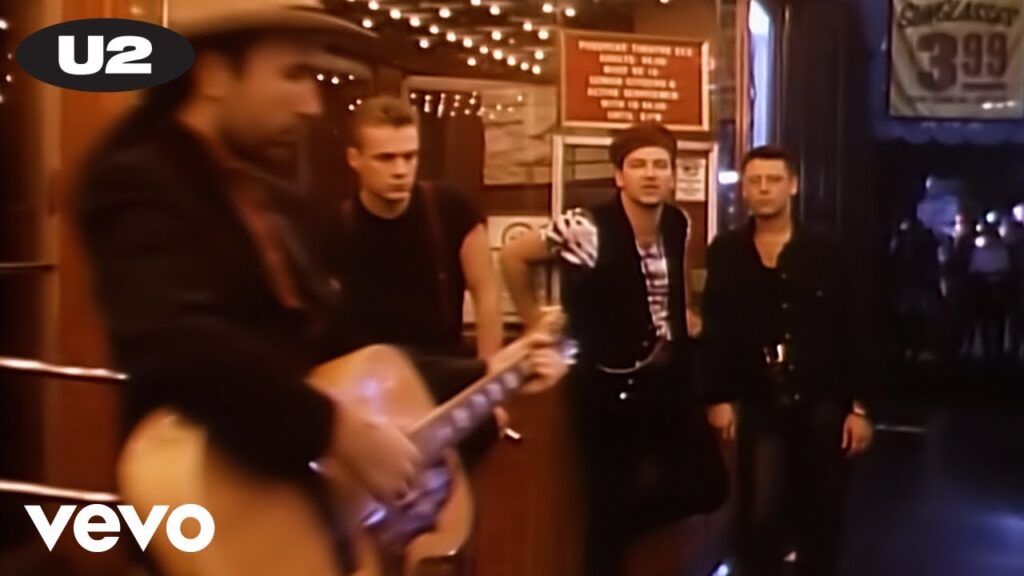
The Blues-Driven Hit That Kicked Off a New Era for U2
Released in September 1988 as the lead single from Rattle and Hum, “Desire” marked another bold shift for U2. After conquering the world with the monumental success of The Joshua Tree, the band could have easily repeated that formula. Instead, Bono, The Edge, Adam Clayton, and Larry Mullen Jr. leaned even further into their love of American roots music, blending rock, blues, and gospel influences into a gritty, swagger-filled anthem that became their first No. 1 single in the United Kingdom.
In the United States, “Desire” reached the Top 5 on the Billboard Hot 100 and became a massive hit on rock radio. Powered by a hypnotic Bo Diddley-inspired beat, Bono’s passionate vocals, and The Edge’s razor-sharp guitar work, the song proved that U2 could continue evolving without losing the identity that made them one of the biggest bands in the world.
More than thirty-five years later, “Desire” remains one of U2’s defining late-1980s recordings and a concert favorite that still ignites audiences from its opening rhythm.
Following a Landmark Album
By 1988, U2 had reached a level of popularity few rock bands ever experience.
The Joshua Tree had transformed them from arena headliners into global superstars with classics like “With or Without You,” “Where the Streets Have No Name,” and “I Still Haven’t Found What I’m Looking For.”
Rather than immediately chasing another polished studio masterpiece, the band decided to explore the American musical traditions that had long inspired them.
Rattle and Hum became part studio album, part live album, and part musical journey through blues, gospel, country, and early rock and roll.
“Desire” served as the perfect introduction to that new direction.
Songwriting
“Desire” explores temptation in many forms.
On the surface, the lyrics describe physical attraction and longing, but Bono leaves plenty of room for broader interpretation. Desire can represent love, fame, money, addiction, ambition, or any powerful force that drives human behavior.
That ambiguity gives the song much of its lasting appeal.
Listeners can interpret its meaning through their own experiences.
The lyrics also feature vivid imagery and biblical references that became a hallmark of Bono’s writing throughout the 1980s.
Rather than presenting easy answers, he invites listeners to wrestle with the questions themselves.
The chorus is deceptively simple.
Its repetition reinforces the obsessive nature of desire itself, making the song’s structure perfectly match its subject.
Bono’s Performance
Bono delivers one of the rawest vocal performances of his career.
Instead of the soaring emotional style heard on many The Joshua Tree songs, he adopts a grittier, bluesier approach that perfectly fits the material.
His voice carries urgency and swagger while maintaining the emotional sincerity that has always defined his singing.
Every line feels spontaneous, as though he’s discovering the song in real time.
That sense of immediacy gives “Desire” much of its energy.
The Edge’s Guitar Work
Although “Desire” is driven by rhythm, The Edge remains central to its success.
Rather than relying on the echo-heavy style heard in many earlier U2 classics, he delivers a sharper, dirtier guitar tone inspired by classic rock and blues.
His riffs are economical but unforgettable.
Every note serves the groove rather than drawing attention to technical complexity.
It’s a reminder that great guitar playing isn’t always about playing more—it’s about playing exactly what’s needed.
Production
Produced by Jimmy Iovine alongside U2, “Desire” embraces a stripped-down rock sound.
The arrangement features:
- Bo Diddley-inspired rhythm
- Crunching electric guitars
- Driving bass lines
- Tight live drums
- Subtle backing vocals
- Minimal studio effects
Unlike many heavily layered recordings of the late 1980s, “Desire” feels almost live.
The band sounds as though they’re playing together in the same room, giving the recording tremendous energy and authenticity.
That rawness distinguishes it from much of the era’s polished arena rock.
Chart Success
“Desire” became another major milestone for U2.
The song reached:
- No. 1 on the UK Singles Chart
- No. 3 on the Billboard Hot 100
- No. 1 on the Mainstream Rock chart
- Top 10 in numerous countries worldwide
The single helped propel Rattle and Hum to multi-platinum success and demonstrated that U2’s popularity extended far beyond one breakthrough album.
It also earned the band a Grammy Award for Best Rock Performance by a Duo or Group with Vocal.
Why It Still Works
An Unforgettable Groove
The Bo Diddley-inspired rhythm immediately grabs attention and never lets go.
It’s one of the band’s most distinctive musical foundations.
Bono’s Passion
His gritty vocal performance perfectly captures the song’s themes of obsession and temptation.
Outstanding Band Chemistry
Every member contributes equally.
Larry Mullen Jr.’s drumming, Adam Clayton’s bass, The Edge’s guitar, and Bono’s vocals lock together beautifully.
A Different Side of U2
Rather than repeating previous successes, the band embraced new influences while remaining unmistakably themselves.
That willingness to evolve helped sustain their remarkable career.
Cultural Impact
“Desire” marked an important chapter in U2’s artistic evolution.
It demonstrated that one of the world’s biggest rock bands wasn’t afraid to take creative risks after achieving enormous commercial success.
The song has remained a fixture of U2’s live performances, where its infectious rhythm consistently energizes audiences.
It also helped introduce younger listeners to the blues and early rock influences that shaped much of modern music.
Legacy
Although The Joshua Tree often receives greater acclaim, “Desire” stands as one of U2’s strongest late-1980s singles.
It captures the band at a moment of artistic confidence, willing to challenge both themselves and their audience.
Its blend of blues, rock, and spiritual imagery continues to sound fresh decades after its release.
Among U2’s many hit singles, it remains one of the most immediately recognizable.
Final Thoughts
“Desire” is proof that great bands continue evolving rather than repeating themselves.
U2 successfully followed one of the greatest albums in rock history by embracing new musical influences while preserving the passion, intelligence, and emotional depth that made them unique.
The result is a raw, energetic, and endlessly compelling recording that continues to rank among the band’s finest work.
Whether experienced through headphones or in front of 80,000 fans at a stadium concert, “Desire” still delivers the same excitement it did in 1988.
This post has already been read 67 times!