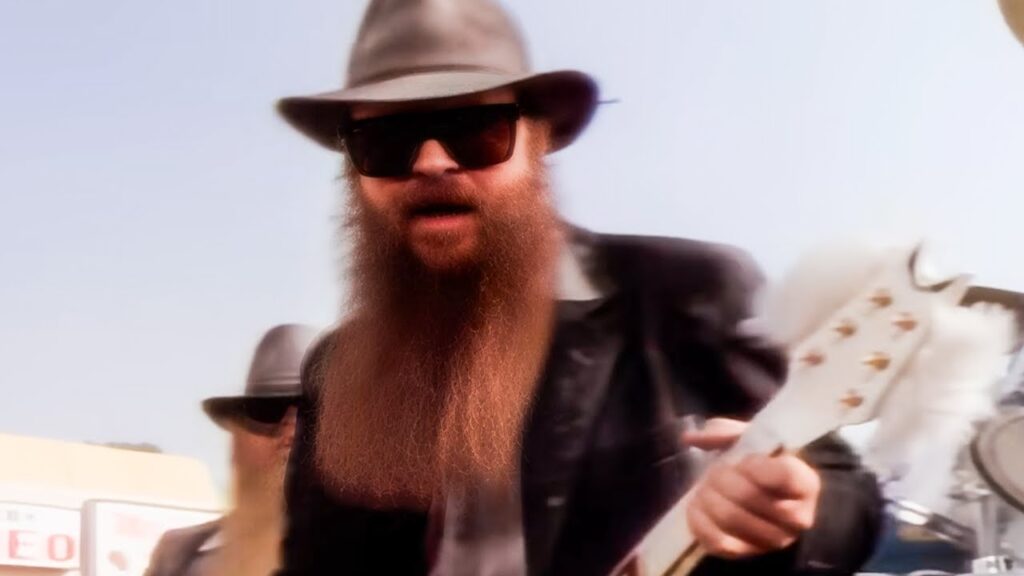
Released in July 1984 as the fourth single from Eliminator, “Legs” became the song that transformed ZZ Top from a respected Texas blues-rock trio into one of the biggest bands on the planet. While longtime fans had followed Billy Gibbons, Dusty Hill, and Frank Beard since the early 1970s, “Legs” introduced them to an entirely new generation through a groundbreaking combination of blues-rock guitar, synthesizers, and one of MTV’s most iconic music videos. It remains one of the band’s signature songs and one of the defining rock records of the 1980s.
By the time “Legs” was released, ZZ Top had already built an impressive career. Albums such as Tres Hombres and Fandango! produced classics like “La Grange” and “Tush,” earning the trio a reputation as one of America’s finest blues-rock bands. Yet by the early 1980s, changing musical tastes threatened to leave many traditional rock groups behind. Instead of resisting new technology, ZZ Top embraced it in a way that retained their identity while opening the door to massive commercial success.
The result was Eliminator, released in 1983.
The album became a phenomenon, producing hit after hit and selling more than ten million copies in the United States alone. Alongside songs like “Gimme All Your Lovin’,” “Sharp Dressed Man,” and “TV Dinners,” “Legs” helped turn the trio into international superstars.
Written by Billy Gibbons, Dusty Hill, and Frank Beard, “Legs” is built around one of the simplest but most effective concepts in rock music. The lyrics celebrate attraction and confidence without becoming overly complicated. Billy Gibbons delivers them with his trademark cool, relying more on attitude than elaborate storytelling. His understated vocal style perfectly complements the song’s swagger.
Musically, however, “Legs” represented a dramatic evolution for ZZ Top.
The opening is driven by an electronic synthesizer pattern rather than a traditional blues guitar riff. This immediately announced that the band wasn’t interested in simply repeating its earlier sound. Yet once Billy Gibbons’ guitar enters, the song remains unmistakably ZZ Top. His crunchy tone, blues phrasing, and tasteful fills provide the perfect balance against the sleek electronic backdrop.
That contrast became one of the defining sounds of Eliminator. Rather than allowing synthesizers to replace the band’s identity, producer Bill Ham successfully blended modern technology with classic Texas blues-rock. The result appealed equally to longtime rock fans and younger listeners raised on synth-pop and MTV.
Billy Gibbons’ guitar work is, as always, exceptional. Instead of relying on long solos, he focuses on memorable hooks and economical phrasing. Every note serves the song, demonstrating why Gibbons is widely regarded as one of rock’s most tasteful guitarists. His ability to combine blues tradition with modern production helped make “Legs” one of the era’s most distinctive recordings.
Dusty Hill’s bass playing provides the groove that anchors the arrangement. While the synthesizers receive much of the attention, Hill’s steady bass lines give the recording warmth and drive. Frank Beard’s drumming is equally impressive, blending live percussion with electronic elements in a way that never feels forced or artificial.
The production remains remarkably polished. Bill Ham understood that contemporary audiences wanted bright, punchy recordings, but he wisely preserved enough grit to keep the band sounding authentic. Even after four decades, “Legs” retains its energy because the production never overwhelms the musicianship.
Commercially, the song became ZZ Top’s biggest crossover success. It reached No. 8 on the Billboard Hot 100, making it the band’s highest-charting single in the United States. It also became a major hit on the Mainstream Rock chart while receiving constant rotation on MTV.
The music video played an enormous role in that success.
Directed by Tim Newman, the video continued the storyline established in earlier Eliminator videos, featuring the famous red 1933 Ford coupe, the band’s sharply dressed image, and a trio of glamorous women helping an ordinary shoe-store employee gain confidence and transform her life. Like “Sharp Dressed Man” and “Gimme All Your Lovin’,” the video mixed humor, fantasy, and rock-and-roll attitude in a way that became instantly recognizable.
Those videos made ZZ Top unlikely MTV superstars. Billy Gibbons and Dusty Hill’s matching long beards, sunglasses, and hats became iconic visual trademarks, while Frank Beard’s ironic lack of a beard only added to the band’s unique personality.
Looking back, “Legs” represents one of rock music’s most successful reinventions. Many veteran bands attempted to modernize during the 1980s, but few managed it as naturally as ZZ Top. They adopted synthesizers and contemporary production without sacrificing the blues foundation that had defined their music from the beginning.
The song also demonstrated Billy Gibbons’ remarkable songwriting instincts. Although “Legs” is built around a relatively simple concept, its unforgettable chorus, infectious groove, and perfectly balanced arrangement make it one of those rare songs that remains instantly recognizable after only a few notes.
Today, “Legs” continues to receive heavy airplay on classic rock and classic hits radio stations. It remains a concert favorite and one of the highlights of ZZ Top’s catalog. The song frequently appears in films, television shows, commercials, and sports arenas, introducing new generations to the band’s unmistakable sound.
More than forty years after its release, “Legs” stands as one of the defining rock singles of the 1980s. Its innovative blend of blues guitar, synthesizers, polished production, and unforgettable hooks transformed ZZ Top into global superstars while proving that even the most established bands could successfully embrace change. It remains a perfect example of how evolution, when guided by confidence and great songwriting, can produce timeless music.
This post has already been read 60 times!