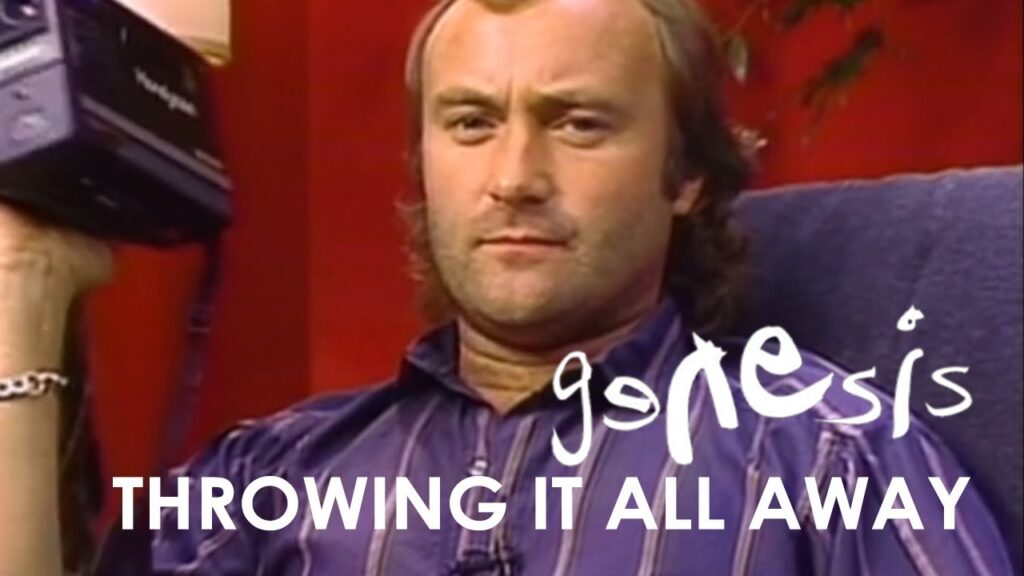
By the mid-1980s, Genesis had completed one of the most remarkable transformations in rock history. Once known primarily as a progressive rock band celebrated for lengthy compositions and elaborate concepts, the group had evolved into one of the world’s biggest pop-rock acts. Their 1986 album Invisible Touch became a commercial powerhouse, producing an astonishing five Top 5 singles in the United States. Among them was “Throwing It All Away,” a heartfelt ballad that showcased the band’s ability to combine emotional honesty with irresistible pop craftsmanship.
Released as the fourth single from the album, “Throwing It All Away” climbed to No. 4 on the Billboard Hot 100, giving Genesis another major international hit. While it often sits in the shadow of chart-toppers like “Invisible Touch,” “Land of Confusion,” and “Tonight, Tonight, Tonight,” many fans consider it one of the group’s most emotionally satisfying songs. Built around a simple acoustic guitar progression, soaring melodies, and Phil Collins’ unmistakable voice, it remains one of the defining adult contemporary hits of the decade.
The Story Behind the Song
By the time Genesis entered the studio to record Invisible Touch, the trio of Phil Collins, Tony Banks, and Mike Rutherford had developed a unique collaborative writing process. Rather than arriving with fully completed songs, they often created music through improvisation, building arrangements together until memorable ideas emerged naturally.
“Throwing It All Away” grew out of one of those sessions. Once the basic musical framework had taken shape, Phil Collins wrote lyrics about a relationship that has reached a crossroads. Instead of focusing on anger or blame, the song explores regret and the realization that both people may be responsible for letting something valuable slip away.
The composition reflected one of Genesis’ greatest strengths during the 1980s: their ability to write emotionally relatable songs without becoming overly sentimental. The result was a ballad that felt genuine, mature, and accessible.
Appearing on one of the biggest-selling albums of the decade, the song became another example of Genesis’ extraordinary ability to balance commercial success with consistently high-quality songwriting.
The Sound
Unlike many of the more elaborate productions on Invisible Touch, “Throwing It All Away” begins with a simple acoustic guitar figure that immediately establishes an intimate atmosphere.
As the song progresses, keyboards, bass, drums, and electric guitars gradually enter, expanding the arrangement without overwhelming its emotional core. Producer Hugh Padgham and the band carefully control the dynamics, allowing the recording to build naturally toward its powerful chorus.
Tony Banks’ keyboards provide rich harmonic textures while Mike Rutherford’s guitar work remains tasteful and understated throughout. Phil Collins’ drums are precise yet restrained, demonstrating that technical skill often means knowing when not to overplay.
The production is unmistakably rooted in the mid-1980s, featuring polished synthesizers and the band’s signature drum sound, yet it avoids the excesses that dated many recordings from the era. The emphasis remains squarely on melody, performance, and emotional connection.
Performance and Musicianship
Phil Collins delivers one of his most sincere vocal performances with Genesis.
His voice conveys vulnerability without sounding fragile, perfectly matching the song’s reflective tone. Rather than relying on dramatic vocal flourishes, Collins allows subtle changes in phrasing and dynamics to communicate the emotion, making the performance feel authentic from beginning to end.
Mike Rutherford’s acoustic guitar provides the song’s foundation, demonstrating how a simple chord progression can become incredibly effective when paired with strong songwriting. Tony Banks adds layers of keyboards that enrich the arrangement while never distracting from the vocal.
The rhythm section maintains a steady pulse throughout, creating a sense of forward motion that mirrors the emotional progression of the lyrics. Every musician serves the composition, highlighting the remarkable chemistry that had developed among the trio after years of performing and writing together.
The result is a performance that feels polished yet deeply human.
Why It Worked
Several factors helped “Throwing It All Away” become another Top 5 hit for Genesis.
First, the melody is instantly memorable. The chorus arrives naturally and remains one of the band’s strongest sing-along moments, making it immediately accessible to both longtime fans and casual listeners.
Second, the song’s emotional theme is universal. Nearly everyone has experienced the painful realization that a relationship is slipping away, and Genesis captured that feeling with honesty rather than melodrama.
The timing also worked in the band’s favor. By 1986, Genesis had become one of the biggest acts on radio and MTV, and every single from Invisible Touch received enormous attention. The accompanying music video, featuring the band performing in a simple rehearsal-style setting, emphasized their chemistry and musicianship rather than elaborate visual effects.
Perhaps most importantly, the song demonstrated that Genesis could write sophisticated pop music without sacrificing the musical intelligence that had earned them devoted fans during their progressive rock years.
The Legacy
Although Invisible Touch produced multiple iconic singles, “Throwing It All Away” has maintained a special place among Genesis fans.
It became a regular highlight of the band’s live performances, with audiences enthusiastically participating during the chorus by tossing their arms from side to side in unison. That simple gesture turned the song into one of the most engaging moments of Genesis concerts and later Phil Collins’ solo shows.
The recording also serves as an excellent example of the band’s evolution. It combines accessible songwriting with tasteful musicianship, illustrating why Genesis succeeded where many progressive rock bands struggled during the changing musical landscape of the 1980s.
Today, “Throwing It All Away” remains a staple on classic hits and adult contemporary radio. It continues to introduce new listeners to one of the strongest periods in Genesis’ remarkable career while reminding longtime fans why Invisible Touch became one of the decade’s defining albums.
Final Thoughts
“Throwing It All Away” is one of Genesis’ finest ballads, proving that emotional simplicity can be just as powerful as musical complexity. Built around memorable melodies, understated performances, and polished production, the song captures the quiet heartbreak of realizing something precious is slipping away.
Phil Collins’ heartfelt vocal, combined with Tony Banks’ elegant keyboard work and Mike Rutherford’s tasteful guitar playing, creates a recording that has aged remarkably well. Rather than relying on dramatic gestures, the band trusts the strength of the composition—and that confidence pays off beautifully.
More than forty years after its release, “Throwing It All Away” remains one of the standout moments in Genesis’ catalog. It represents a band at the height of its commercial success while still delivering music with depth, sincerity, and craftsmanship. As both a timeless breakup song and an outstanding example of sophisticated pop-rock, it continues to earn its place among the very best recordings of the 1980s.
This post has already been read 74 times!