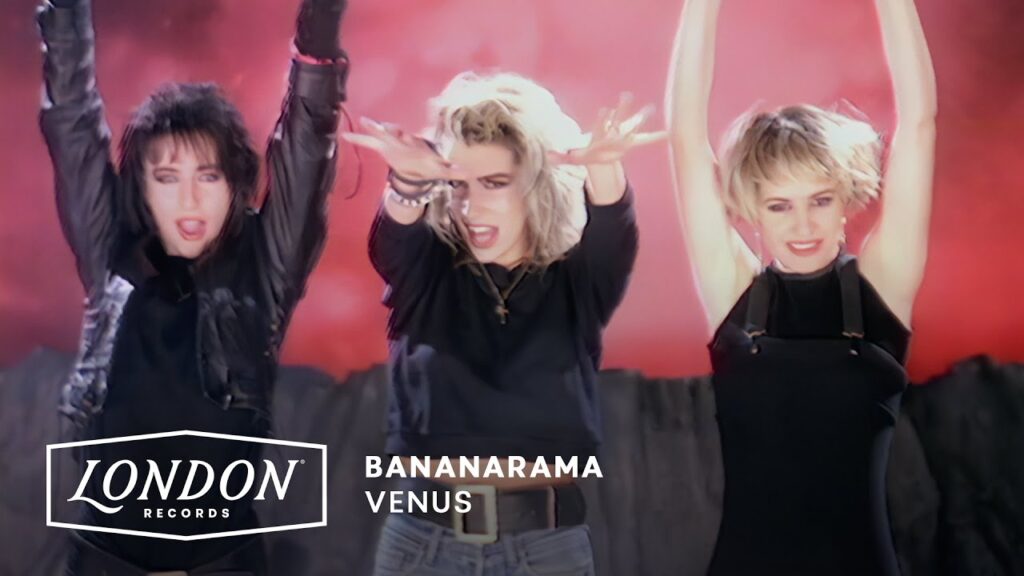
Released in July 1986 as the lead single from True Confessions, “Venus” became Bananarama’s biggest international hit and one of the most recognizable dance-pop songs of the 1980s. Although the song had originally been a chart-topper for Dutch rock band Shocking Blue in 1970, Bananarama transformed it into a vibrant synth-pop anthem that perfectly captured the sound of the MTV era. Their version reached No. 1 on the Billboard Hot 100 and topped charts around the world, introducing a new generation to one of pop music’s most enduring melodies.
More than thirty-five years later, “Venus” remains the song most closely associated with Bananarama. Its infectious beat, bold production, and unforgettable chorus continue to make it a staple on ’80s playlists, dance floors, and classic pop radio.
Reinventing a Classic
Covering a well-known hit can be risky.
Listeners often compare every new version to the original, and many remakes struggle to establish their own identity. Bananarama avoided that trap by taking “Venus” in an entirely different direction.
Where Shocking Blue’s original leaned heavily on psychedelic rock and blues influences, Bananarama embraced polished dance-pop. The familiar melody remained, but nearly everything else—from the instrumentation to the rhythm—was modernized for the mid-1980s.
The result was less a cover than a complete reinvention.
Teaming with Stock Aitken Waterman
A major reason for the song’s success was the involvement of legendary production trio Stock Aitken Waterman.
Known for crafting polished, hook-filled pop records, the team had already become one of the most successful hit-making forces of the decade. Their production combined crisp electronic drums, layered synthesizers, and infectious dance rhythms that dominated radio and clubs throughout the late 1980s.
For “Venus,” they created an arrangement that was energetic without overwhelming the song’s memorable melody.
Their production helped transform the track into an international smash.
Bananarama’s Confident Performance
Unlike many vocal groups that relied on powerhouse soloists, Bananarama’s strength came from their chemistry.
Sara Dallin, Keren Woodward, and Siobhan Fahey delivered “Venus” with confidence, attitude, and personality. Their vocals blend naturally throughout the song, giving it an effortless energy that perfectly matches the upbeat arrangement.
Rather than trying to imitate the original recording, the trio made the song unmistakably their own.
That confidence became one of the defining characteristics of Bananarama’s career.
The Power of Simplicity
Part of what makes “Venus” so memorable is its straightforward structure.
The chorus is instantly recognizable, the rhythm is impossible to ignore, and the melody stays with listeners long after the song ends. Every element is designed to be accessible without sacrificing musical sophistication.
The repeated title hook becomes more effective with each appearance, making the song ideal for radio, clubs, and live performances alike.
Sometimes the simplest ideas become the most enduring.
The Music Video
The music video became one of MTV’s defining clips of 1986.
Featuring surreal imagery inspired by mythology, fashion, and fantasy, the video presented each member of Bananarama in striking costumes while embracing colorful visual effects that reflected the era’s imaginative style.
The playful visuals perfectly matched the song’s energetic spirit and helped expand the group’s popularity in the United States, where MTV exposure often played a crucial role in breaking international artists.
It remains one of the band’s most memorable videos.
Conquering the Charts
“Venus” became Bananarama’s greatest commercial achievement.
The single reached No. 1 on the Billboard Hot 100 in the United States, making them one of the few British girl groups to top the American charts during the 1980s. It also climbed to the Top 10 in numerous countries, including the United Kingdom, Australia, Canada, Germany, and across much of Europe.
The success of “Venus” helped True Confessions become Bananarama’s most successful album internationally and cemented their status as global pop stars.
For many listeners outside the UK, it remains the song that introduced them to the trio.
Why the Cover Worked
Not every remake improves upon the original, but “Venus” succeeded because it respected the strength of the songwriting while updating everything around it.
The melody remained timeless, yet the modern production gave it a completely different personality. Stock Aitken Waterman’s sleek arrangement fit perfectly with Bananarama’s playful image and vocal style.
The song never feels like an attempt to copy Shocking Blue.
Instead, it feels like a celebration of a great composition viewed through the lens of 1980s dance-pop.
Lasting Influence
Bananarama’s version of “Venus” has become so popular that many listeners assume it is the original recording.
The song has appeared in films, television shows, commercials, sporting events, and countless nostalgic compilations. Its energetic rhythm also made it a favorite for dance remixes, introducing it to new audiences over the years.
It remains one of the definitive examples of how an older hit can be successfully reimagined for a completely different musical generation.
Legacy
“Venus” stands as one of the finest pop remakes ever recorded. Bananarama took an already excellent song and transformed it into a sparkling dance anthem that perfectly captured the optimism, style, and production values of the mid-1980s.
For the trio, it became the defining hit of an already impressive career filled with memorable singles. It also demonstrated the extraordinary hit-making abilities of Stock Aitken Waterman, whose production shaped much of late-1980s pop music.
Nearly four decades after it topped the charts, “Venus” continues to inspire singalongs, fill dance floors, and soundtrack celebrations around the world. Whether listeners first discovered it through MTV, radio, or streaming playlists, its irresistible melody and infectious energy ensure that Bananarama’s version remains one of the most beloved pop classics of the 1980s.
This post has already been read 85 times!