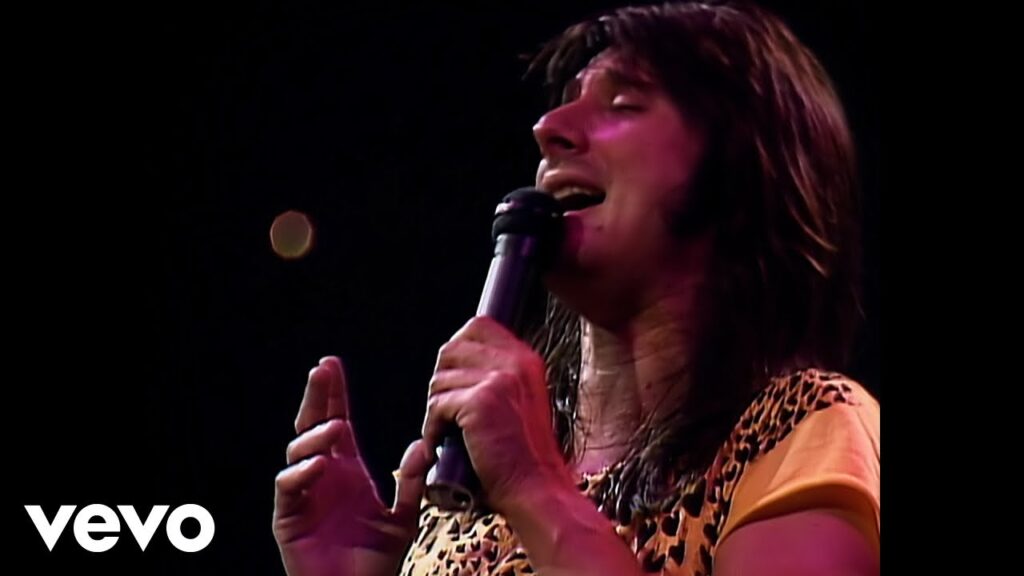
Few songs have experienced a second life as extraordinary as “Don’t Stop Believin'” by Journey. Released in 1981, it was certainly a successful single, but no one could have predicted that decades later it would become one of the most recognizable rock songs ever recorded. Today, it has transcended generations, becoming a staple at sporting events, karaoke bars, weddings, graduation ceremonies, and concerts around the world.
Its opening piano notes are instantly recognizable. Before Steve Perry even begins to sing, audiences know exactly what’s coming. Within seconds, thousands of voices often join in, creating one of the most communal experiences in popular music.
While Journey produced numerous classic rock hits throughout the late 1970s and early 1980s, “Don’t Stop Believin'” ultimately became the song that defined their career. Its message of hope, perseverance, and chasing dreams continues to resonate just as strongly today as it did when it first hit the airwaves more than forty years ago.
Journey Finds Its Voice
Journey formed in San Francisco in 1973, initially earning a reputation as a technically gifted rock band with roots in jazz fusion. Early albums showcased impressive musicianship but struggled to find mainstream commercial success.
Everything changed in 1977 with the arrival of Steve Perry.
Perry’s soaring tenor voice gave Journey an entirely new identity. Combined with the songwriting talents of guitarist Neal Schon and keyboardist Jonathan Cain, the band began creating arena-ready rock songs that balanced instrumental excellence with unforgettable melodies.
Albums like Evolution and Departure steadily increased the band’s popularity, but it was 1981’s Escape that transformed Journey into international superstars.
“Don’t Stop Believin'” would become the album’s emotional centerpiece.
Born from Three Songwriters
The song was written collaboratively by Steve Perry, Neal Schon, and Jonathan Cain, with each contributing one of its defining elements.
Jonathan Cain brought the famous piano introduction, inspired in part by advice his father had given him years earlier.
After Cain struggled as a musician in Los Angeles before joining Journey, his father repeatedly encouraged him to keep pursuing his dreams, reminding him to “don’t stop believing.”
That simple phrase stayed with Cain.
Years later, it became one of the most famous song titles in rock history.
Steve Perry developed many of the lyrics, creating vivid snapshots of ordinary people searching for something more meaningful in life.
Together, the trio crafted a song that felt deeply personal while speaking to universal experiences.
Ordinary People, Extraordinary Dreams
Unlike many rock songs of the era, “Don’t Stop Believin'” doesn’t focus on glamorous lifestyles or larger-than-life heroes.
Instead, it introduces everyday people.
A small-town girl.
A city boy.
Strangers searching for opportunity.
The characters remain deliberately undefined, allowing listeners to imagine themselves inside the story.
The song isn’t really about one relationship.
It’s about possibility.
It’s about believing tomorrow might bring something better than today.
That emotional openness explains much of its lasting appeal.
Listeners from virtually every background can identify with the desire for a better future.
A Remarkably Unusual Structure
One reason “Don’t Stop Believin'” stands apart from other rock hits is its unconventional composition.
Most pop songs introduce the chorus relatively early.
Journey does the exact opposite.
The song spends nearly its entire running time building anticipation through verses and instrumental passages before finally delivering the full chorus during the closing moments.
Under normal circumstances, this might seem like a risky decision.
Instead, it creates one of the greatest payoffs in rock music.
By the time Steve Perry finally sings the title phrase in its complete form, listeners have already been emotionally invested for several minutes.
The release feels enormous.
It’s songwriting built on patience.
Steve Perry’s Defining Performance
Steve Perry has recorded countless memorable vocals throughout his career, but “Don’t Stop Believin'” may represent his finest achievement.
He begins gently, allowing the story to unfold naturally.
As the arrangement grows, his voice rises with it, becoming increasingly powerful without sacrificing clarity or emotion.
Few rock singers possessed Perry’s ability to combine technical excellence with genuine feeling.
His voice carries hope, determination, vulnerability, and confidence all at once.
Rather than overwhelming the listener, he invites them to join him.
That sense of shared experience is a major reason audiences instinctively sing along whenever the song is played.
Building Tension Note by Note
Musically, “Don’t Stop Believin'” is a masterclass in gradual escalation.
Jonathan Cain’s iconic piano introduces the melody with elegant simplicity.
Ross Valory’s bass provides a steady foundation.
Steve Smith’s drumming remains restrained for much of the song, allowing tension to build naturally.
Neal Schon’s guitar avoids dominating the arrangement, instead adding tasteful accents that enhance the emotional momentum.
Every instrument arrives exactly when needed.
Nothing feels rushed.
The production rewards patience, steadily expanding until the final chorus becomes almost impossible not to sing at full volume.
It’s a lesson in musical dynamics that countless bands have tried to emulate.
Success That Grew Over Time
When released as the lead single from Escape, “Don’t Stop Believin'” performed well commercially, reaching the Top 10 on the Billboard Hot 100.
It became one of Journey’s biggest hits, but at the time, songs like “Open Arms” actually achieved even higher chart positions.
Its greatest success, however, was still years away.
Unlike many hit singles that gradually fade from public memory, “Don’t Stop Believin'” became increasingly popular as time passed.
Radio stations continued playing it.
Classic rock audiences embraced it.
Younger listeners discovered it through films, television, and streaming services.
Eventually, it became one of the best-selling digital songs from the twentieth century.
Very few recordings have enjoyed such remarkable longevity.
A Cultural Phenomenon
The song’s popularity exploded once again during the 2000s thanks to several high-profile appearances in popular culture.
Its unforgettable use during the final scene of the television drama The Sopranos introduced it to millions of new viewers and sparked endless discussion about one of television’s most famous endings.
Not long afterward, the television series Glee featured the song prominently, exposing it to an entirely different generation. Suddenly, teenagers who had never owned a Journey album were singing along to a rock anthem released before they were born.
Sports teams also embraced the song, playing it during games to energize crowds. Fans quickly adopted it as a communal singalong, transforming arenas into massive choirs.
Few songs have crossed as many cultural boundaries.
Why It Endures
The lasting appeal of “Don’t Stop Believin'” comes down to several timeless qualities.
First is its message.
Hope never goes out of style. Regardless of the decade, people continue searching for encouragement during difficult moments.
Second is the melody.
From the opening piano to the soaring finale, nearly every section feels instantly memorable.
Third is the performance.
Steve Perry’s vocal captures optimism without sounding naïve, making the emotional core believable.
Finally, the song invites participation.
It’s almost impossible to remain silent when the closing chorus arrives.
Listeners don’t simply hear “Don’t Stop Believin’.”
They become part of it.
More Than Journey’s Biggest Hit
Journey has built an extraordinary catalog that includes classics like “Wheel in the Sky,” “Separate Ways (Worlds Apart),” “Faithfully,” “Any Way You Want It,” and “Open Arms.” Any of those songs would be enough to secure a band’s place in rock history.
Yet “Don’t Stop Believin'” stands above them all.
It has become more than a hit single.
It’s a symbol of resilience.
Its message has inspired graduates stepping into uncertain futures, athletes preparing for championship games, workers chasing lifelong ambitions, and countless people simply trying to make it through difficult times.
More than four decades after its release, the song continues to unite audiences in a way few recordings ever have. Every performance becomes less of a concert and more of a shared celebration, with thousands of strangers singing together as though they’ve known one another for years.
That’s the true legacy of “Don’t Stop Believin’.”
It reminds listeners that hope can be powerful, dreams are worth chasing, and sometimes the greatest songs aren’t measured by where they first landed on the charts—but by how deeply they become woven into people’s lives.
This post has already been read 81 times!