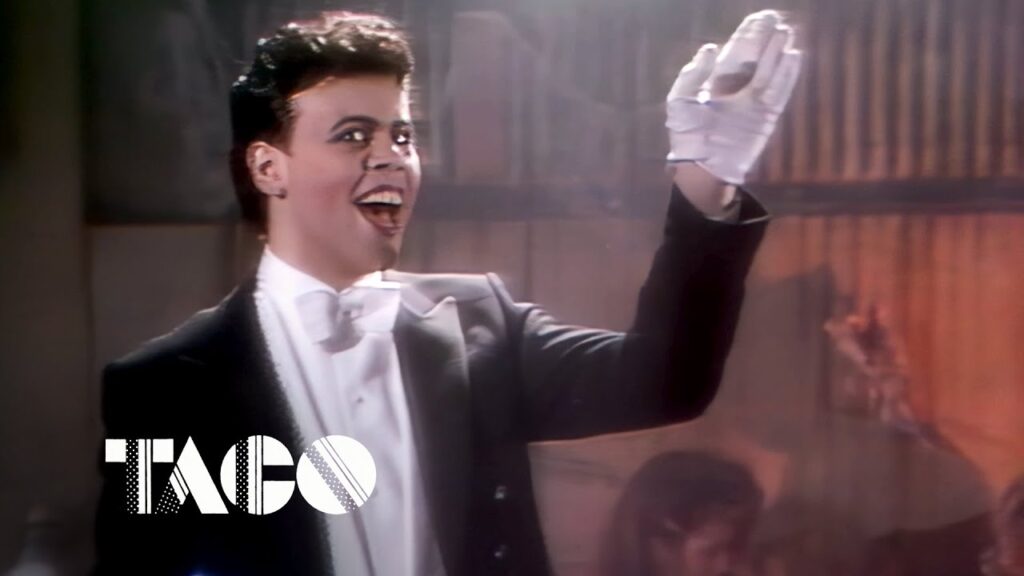
Every once in a while, a song from another era finds new life in a completely different musical landscape. That was exactly what happened when Taco released his dazzling version of “Puttin’ on the Ritz” in 1982. By blending a classic composition from the 1920s with modern synthesizers, dance rhythms, and unmistakable new wave style, Taco created one of the most distinctive hits of the decade.
At a time when MTV was transforming the music industry and synthesizer-driven pop dominated the charts, few artists would have thought to revive an Irving Berlin standard. Yet Taco’s bold approach paid off spectacularly, turning a song written more than fifty years earlier into an international smash.
More than forty years later, his version of “Puttin’ on the Ritz” remains one of the most unique crossover hits in pop history—a recording that celebrates both the elegance of the past and the creativity of the 1980s.
Who Was Taco?
Despite his memorable stage name, Taco Ockerse, known professionally simply as Taco, wasn’t a one-hit wonder who appeared out of nowhere.
Born in Indonesia to Dutch parents and later raised in Europe, Taco studied dance and theater before pursuing a music career. His background in performance would prove essential to his success, as he approached songs not merely as recordings but as complete theatrical experiences.
Unlike many pop singers of the era, Taco embraced vintage fashion, classic Hollywood glamour, and Broadway-inspired presentation.
His artistic identity made “Puttin’ on the Ritz” a perfect fit.
A Song with Deep Roots
Long before Taco recorded it, “Puttin’ on the Ritz” had already become one of America’s great standards.
Written by legendary composer Irving Berlin in 1927, the song celebrated fashionable living and sophisticated style. Over the decades, it had been recorded by numerous artists, most famously Fred Astaire, whose elegant performances helped make it a timeless classic.
The phrase “putting on the Ritz” referred to dressing elegantly and living with style, inspired by the luxurious reputation of the Ritz hotels.
By the early 1980s, however, few expected the song to return to mainstream pop radio.
Taco had other ideas.
Reinventing a Classic
Rather than treating Berlin’s composition as a museum piece, Taco completely reimagined it.
The familiar melody remained.
Everything else changed.
Electronic drums replaced traditional orchestration.
Bright synthesizers joined swing-inspired arrangements.
Dance rhythms blended seamlessly with vintage musical traditions.
The result felt surprisingly natural.
Instead of clashing, the old and new complemented one another beautifully.
Listeners enjoyed the nostalgic charm while embracing the contemporary production.
It became one of the earliest examples of successfully updating a classic standard for the MTV generation.
A Performance Full of Personality
Taco’s vocal performance is every bit as important as the production.
Rather than attempting to imitate Fred Astaire or other earlier interpreters, he delivers the song with playful confidence and theatrical flair.
His distinctive accent adds additional charm, making the recording feel international rather than tied to any single musical tradition.
He clearly enjoys every moment.
That enthusiasm becomes contagious.
The performance walks a delicate line between sophistication and humor without ever slipping into parody.
It’s stylish, self-aware, and remarkably entertaining.
MTV’s Perfect Match
The accompanying music video played a massive role in the song’s success.
At a time when visual presentation had become almost as important as the music itself, Taco delivered one of the era’s most memorable videos.
Dressed in a white tuxedo with top hat and cane, he danced through lavish sets inspired by classic Hollywood musicals while modern editing techniques kept everything feeling contemporary.
The video perfectly reflected the song’s unique blend of vintage elegance and 1980s style.
MTV embraced it.
Viewers remembered it.
Together, the song and video became inseparable.
An International Success
Released in 1982, Taco’s version of “Puttin’ on the Ritz” became an unexpected worldwide hit.
It climbed into the Top Five on the Billboard Hot 100 in the United States while also reaching high chart positions across Europe, Canada, Australia, and numerous other countries.
For many younger listeners, Taco’s version became their introduction to Irving Berlin’s songwriting.
The recording demonstrated that great melodies could transcend generations when presented with creativity and respect.
Few cover versions have successfully bridged such a large historical gap.
Why It Worked
Several factors explain the recording’s remarkable success.
First, the source material was already exceptional.
Irving Berlin’s melody remains instantly recognizable.
Second, Taco never tried to modernize the song by stripping away its personality.
Instead, he celebrated its theatrical nature while surrounding it with contemporary production.
Third, the arrangement avoided gimmickry.
Although undeniably rooted in the early 1980s, the recording remains surprisingly tasteful.
Finally, Taco’s charisma ties everything together.
Without his playful confidence, the concept might have felt forced.
Instead, it feels completely natural.
A Song That Continues to Surprise
One reason “Puttin’ on the Ritz” remains so enjoyable is its unpredictability.
New listeners often expect a straightforward pop song.
Instead, they encounter an inventive fusion of jazz, swing, dance music, and synth-pop.
That willingness to ignore musical boundaries feels refreshingly adventurous.
The recording has continued appearing in films, television shows, commercials, and nostalgic playlists celebrating the creativity of the 1980s.
Every new generation seems delighted to discover just how unusual—and how much fun—it really is.
More Than a Novelty
Because of its theatrical presentation and distinctive style, Taco’s recording is sometimes mistakenly dismissed as a novelty hit.
That label overlooks its genuine musical accomplishment.
Successfully reinventing a beloved standard without diminishing its original charm requires exceptional imagination.
Taco achieved exactly that.
His version respects Irving Berlin’s songwriting while confidently establishing its own identity.
Very few cover songs manage such a difficult balancing act.
A Stylish Legacy
Taco may forever be associated with “Puttin’ on the Ritz,” but there are far worse songs to define a career. His imaginative reinvention introduced one of America’s greatest standards to millions of listeners who might never have encountered it otherwise.
The recording remains a fascinating snapshot of early-1980s creativity—a period when artists were increasingly willing to blend genres, eras, and visual styles into something entirely new. Its infectious rhythm, memorable performance, and polished production continue making it one of the decade’s most distinctive hits.
More than forty years after its release, Taco’s “Puttin’ on the Ritz” still feels fresh because it never relied solely on nostalgia or fashionable trends. Instead, it celebrated timeless songwriting while embracing modern innovation.
Sometimes looking backward is the best way to move forward. Taco proved that with style, confidence, and just the right amount of theatrical flair, even a song from the Roaring Twenties could become one of the unforgettable sounds of the 1980s.
This post has already been read 78 times!