Bruce Springsteen has built his career on writing vivid stories about ordinary people chasing extraordinary dreams. His songs often feature restless characters searching for love, redemption, or escape, wrapped in powerful arrangements that range from bar-band rock to sweeping anthems. Yet one of his most haunting and unforgettable recordings is also one of his quietest. Released in 1985 as the fourth single from the landmark album Born in the U.S.A., “I’m on Fire” proved that subtlety could be just as captivating as stadium-sized rock.
Unlike many of Springsteen’s best-known hits, “I’m on Fire” doesn’t rely on booming drums, soaring saxophone solos, or explosive guitar work. Instead, it creates tension through restraint. A hypnotic rhythm, sparse instrumentation, and Springsteen’s intimate vocal performance combine to produce a song that feels mysterious, seductive, and emotionally unsettling. Nearly forty years after its release, it remains one of the most distinctive recordings in his remarkable catalog.
The origins of “I’m on Fire” date back to the marathon recording sessions for Born in the U.S.A.. Those sessions produced dozens of songs spanning multiple musical styles, from full-throttle rock anthems to stripped-down acoustic ballads. According to producer Jon Landau and members of the E Street Band, “I’m on Fire” came together remarkably quickly. Springsteen reportedly wrote and recorded much of it in a single afternoon, a rare occurrence during sessions that often involved countless revisions and alternate versions.
Its simplicity became one of its greatest strengths. While many songs on Born in the U.S.A. were built around thunderous arrangements, “I’m on Fire” occupied the opposite end of the spectrum. That contrast gave the album greater depth and demonstrated Springsteen’s remarkable versatility as both a songwriter and performer.
Musically, the song is a masterclass in minimalism. Max Weinberg’s steady drumbeat provides an understated pulse, while Roy Bittan’s atmospheric keyboards subtly fill the background without drawing attention away from the melody. Garry Tallent’s bass quietly anchors the arrangement, and Springsteen’s clean electric guitar lines leave plenty of space between notes, allowing every musical phrase to linger.
The production, handled by Springsteen, Jon Landau, Chuck Plotkin, and Steve Van Zandt, emphasizes mood over complexity. There are no unnecessary instrumental flourishes or dramatic changes in tempo. Instead, the arrangement slowly pulls the listener into its hypnotic atmosphere, creating a sense of anticipation that never fully resolves.
Springsteen’s vocal performance is among the finest of his career. Rather than delivering the passionate shout associated with songs like “Born to Run” or “Badlands,” he sings in a low, restrained voice that feels almost like a whisper. Every line carries emotional weight, conveying longing, vulnerability, and uncertainty without ever becoming melodramatic.
The song’s lyrics have inspired decades of interpretation. On the surface, they tell the story of overwhelming romantic desire, but the emotional undercurrents are far more complex. The narrator wrestles with obsession, loneliness, and temptation, leaving listeners to decide exactly what motivates his thoughts and actions. Springsteen deliberately avoids providing clear answers, allowing the ambiguity to become part of the song’s enduring appeal.
That openness has contributed to the song’s longevity. Rather than dictating a single meaning, “I’m on Fire” invites listeners to project their own experiences onto its haunting narrative. Some hear it as a straightforward love song, while others interpret it as an exploration of forbidden desire, emotional isolation, or internal conflict.
When released as a single in February 1985, “I’m on Fire” became another major success during Springsteen’s extraordinary commercial run. It reached No. 6 on the Billboard Hot 100, giving Born in the U.S.A. its fourth consecutive Top 10 hit. Internationally, it also performed strongly, charting across Europe, Australia, Canada, and New Zealand while introducing even more listeners to Springsteen’s songwriting.
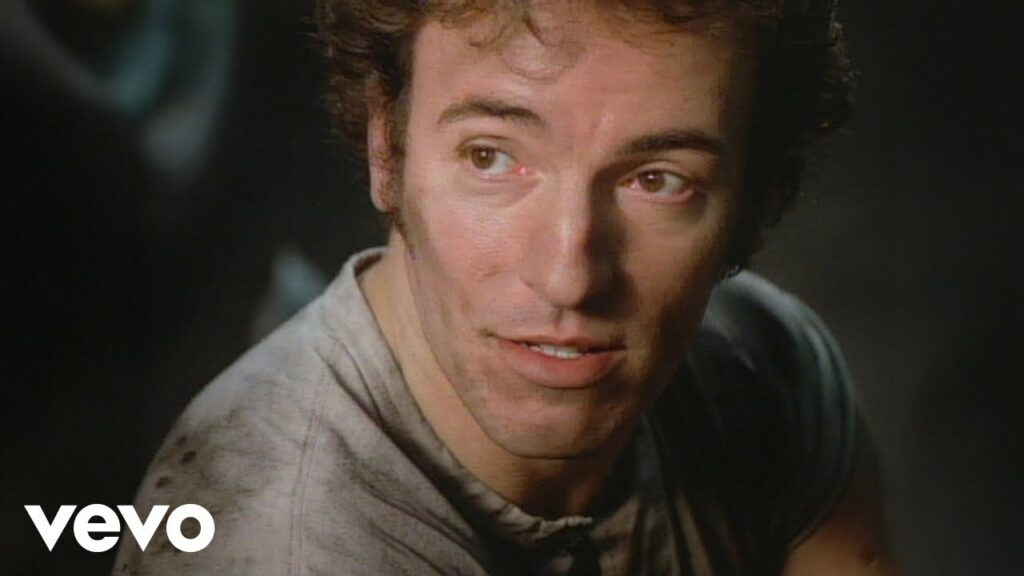
The music video, directed by acclaimed filmmaker John Sayles, reinforced the song’s understated nature. Rather than featuring elaborate performance footage, the video follows Springsteen as a mechanic who develops a quiet connection with a married customer after repairing her classic Ford Thunderbird. The restrained storytelling perfectly complements the song’s emotional ambiguity and remains one of the most memorable videos of the MTV era.
Although Born in the U.S.A. is filled with iconic songs, “I’m on Fire” occupies a unique place within the album. Its understated mood provides a welcome contrast to the record’s larger, louder moments, revealing another side of Springsteen’s artistry. It demonstrates that emotional intensity doesn’t require overwhelming volume; sometimes silence and space can be even more powerful.
Over the years, “I’m on Fire” has become one of Springsteen’s most frequently covered songs. Artists from a wide range of genres—including country, indie rock, alternative, and folk—have recorded their own interpretations. The song’s sparse structure allows performers to reshape it while preserving its emotional core, a hallmark of truly exceptional songwriting.
Its influence extends beyond cover versions. The song’s atmospheric production and minimalist approach anticipated the stripped-down style embraced by many singer-songwriters and alternative artists in the decades that followed. It showed that a pop hit could succeed through mood and intimacy rather than sheer spectacle.
For Bruce Springsteen, “I’m on Fire” remains one of his most beloved live performances. Though it lacks the explosive energy of many E Street Band classics, audiences consistently respond to its hypnotic atmosphere. Each performance allows Springsteen to reinterpret the song subtly, proving its emotional power has never faded.
Today, “I’m on Fire” stands as one of the defining quiet moments in Springsteen’s career. It reminds listeners that one of rock’s greatest storytellers didn’t always need a full band charging behind him to leave a lasting impression. Sometimes a simple rhythm, a haunting melody, and a heartfelt vocal are enough to create something timeless.
Nearly four decades after it first climbed the charts, “I’m on Fire” continues to captivate new audiences through streaming services, film soundtracks, and live performances. Its mysterious atmosphere, emotional honesty, and unforgettable melody ensure it remains one of Bruce Springsteen’s most enduring songs—a haunting classic that burns just as brightly today as it did in 1985.
This post has already been read 78 times!