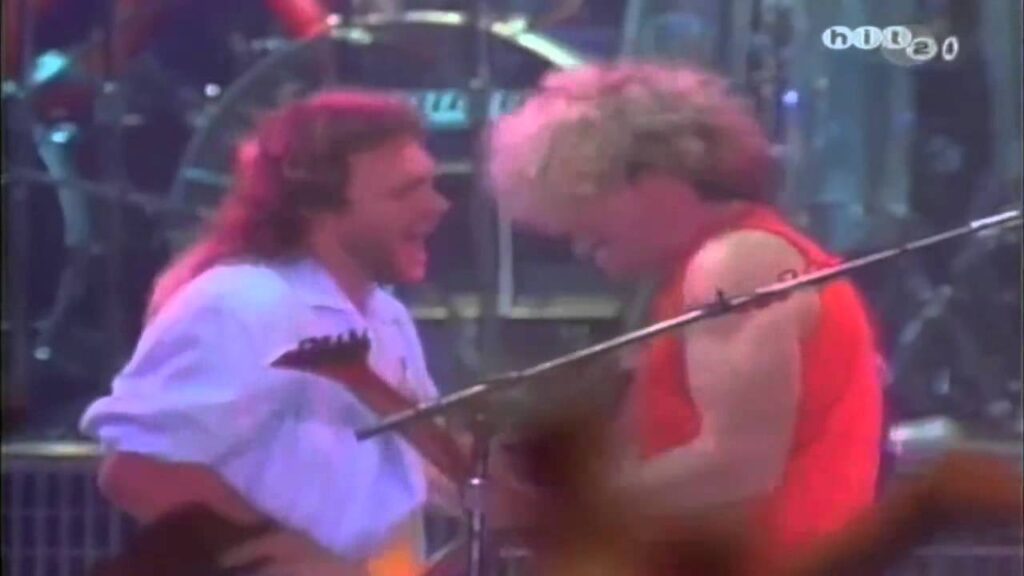
Rock fans knew something significant had changed the moment they heard the opening synthesizer chords of “Why Can’t This Be Love.” Released in March 1986 as the lead single from Van Halen’s album 5150, the song introduced the world to Sammy Hagar as the band’s new lead singer following David Lee Roth’s departure. It was one of the most anticipated—and scrutinized—singles of the decade. Many wondered whether one of rock’s biggest bands could survive such a dramatic lineup change. Instead of merely surviving, Van Halen reinvented themselves, delivering a massive hit that proved the group still had plenty of creative fire left.
Although some longtime fans initially viewed the “Van Hagar” era with skepticism, “Why Can’t This Be Love” quickly demonstrated that the band wasn’t trying to recreate the past. Instead, they embraced a more melodic, keyboard-driven sound while retaining the explosive musicianship that had made them legends. Today, the song stands as one of the defining rock hits of the 1980s and one of the strongest opening chapters of Van Halen’s second era.
The story begins in 1985, when David Lee Roth officially left Van Halen to pursue a solo career. The split shocked the music world. Roth’s charismatic stage presence had become inseparable from the band’s identity, and many critics predicted Van Halen would struggle without him.
Eddie Van Halen, however, had already begun envisioning a broader musical direction. Increasingly interested in keyboards alongside his revolutionary guitar playing, Eddie wanted to explore new melodic possibilities. The arrival of Sammy Hagar proved to be the perfect fit. Already an established solo artist and former frontman of Montrose, Hagar brought a powerful voice, strong songwriting skills, and a collaborative spirit that immediately clicked with the band.
Almost as soon as rehearsals began, it became clear the chemistry was genuine. Rather than forcing Hagar into Roth’s role, Van Halen built songs around the strengths of the new lineup.
“Why Can’t This Be Love” was among the first compositions created during those early sessions, making it the ideal introduction to the band’s new identity.
The song opens with one of Eddie Van Halen’s most recognizable keyboard riffs. Built around bright Oberheim synthesizer tones, the intro immediately signaled a fresh direction. While keyboards had appeared on previous Van Halen recordings—most notably “Jump”—they had never served as the driving force behind a lead single quite like this.
As Alex Van Halen’s drums and Michael Anthony’s unmistakable harmony vocals enter the mix, the song develops into a polished yet energetic rock anthem. Eddie’s guitar remains an essential ingredient, but instead of dominating every moment, it complements the keyboards with tasteful fills, rhythmic accents, and a melodic solo that perfectly serves the song.
Producer Mick Jones, best known as the leader of Foreigner, helped shape the album’s polished sound alongside longtime engineer Donn Landee. The production is clean, spacious, and radio-friendly while preserving the band’s natural energy. Every instrument occupies its own space, allowing listeners to appreciate Eddie’s layered arrangements without sacrificing the group’s trademark power.
The balance between synthesizers and guitars became one of the defining characteristics of 5150. Rather than replacing Van Halen’s hard-rock roots, the keyboards expanded the band’s musical palette.
Sammy Hagar faced enormous pressure stepping into one of rock’s most high-profile jobs, but his performance on “Why Can’t This Be Love” immediately justified the band’s decision. Possessing a wider natural range than many rock vocalists, Hagar delivers the song with confidence, warmth, and emotional sincerity.
Unlike David Lee Roth’s playful swagger, Hagar approaches the lyrics with earnest conviction. His vocal style is more melodic and soulful, emphasizing emotional connection over theatrical performance. That difference became one of the defining characteristics separating the two eras of Van Halen.
Michael Anthony’s signature harmony vocals deserve equal recognition. His soaring backing vocals elevate the chorus, adding richness and helping create one of the band’s most memorable singalong moments.
Lyrically, “Why Can’t This Be Love” explores the uncertainty and excitement that accompany falling deeply in love. Rather than focusing on heartbreak or rebellion, the song celebrates emotional vulnerability and optimism. Hagar’s straightforward delivery reinforces the sincerity of the lyrics, making the narrator’s feelings believable rather than overly sentimental.
The simplicity of the song’s central question gives it universal appeal. Nearly everyone has experienced the hope and anticipation that come with discovering a relationship that feels different from anything before. That emotional accessibility helped broaden Van Halen’s audience beyond traditional hard rock fans.
Released in March 1986, “Why Can’t This Be Love” became an immediate commercial success. The single reached No. 3 on the Billboard Hot 100, making it one of Van Halen’s highest-charting songs and their biggest hit to that point aside from “Jump.” It also performed strongly on rock radio and in international markets, confirming that audiences had embraced the band’s new lineup.
The success of the single propelled 5150 to No. 1 on the Billboard 200, giving Van Halen their first chart-topping album. The record would eventually produce several additional hits, including “Dreams,” “Love Walks In,” and “Best of Both Worlds,” firmly establishing the Sammy Hagar era as a commercial triumph.
The music video received heavy rotation on MTV, introducing fans to the new lineup through energetic studio and performance footage. Rather than trying to recreate the flamboyant visuals associated with David Lee Roth, the video emphasized the chemistry among the four musicians, reinforcing the message that Van Halen remained a united band moving confidently into the future.
Over the years, “Why Can’t This Be Love” has become one of the defining songs of the Hagar era. It remains a staple of classic rock radio and continues to appear prominently in Van Halen compilations and retrospective playlists. Fans who once debated the lineup change often point to this song as proof that the band successfully reinvented itself without abandoning its identity.
The recording also highlighted Eddie Van Halen’s evolution as both a guitarist and composer. While his breathtaking solos had already revolutionized rock guitar, “Why Can’t This Be Love” demonstrated his growing confidence as a songwriter and keyboard player. His willingness to explore new musical directions helped keep Van Halen creatively vibrant during a period when many of their contemporaries struggled to evolve.
Today, “Why Can’t This Be Love” stands as one of the great comeback singles in rock history. It answered critics, reassured fans, and launched a new era that would produce multiple platinum albums and arena tours. More importantly, it proved that change, when embraced creatively, can become an opportunity rather than an obstacle.
Nearly forty years after its release, the song continues to capture everything that made Van Halen exceptional: world-class musicianship, unforgettable hooks, polished production, and an infectious sense of joy. Whether listeners prefer the David Lee Roth years or the Sammy Hagar era, “Why Can’t This Be Love” remains undeniable—a timeless rock anthem that showed one of the greatest bands of all time still had plenty left to say.
This post has already been read 91 times!