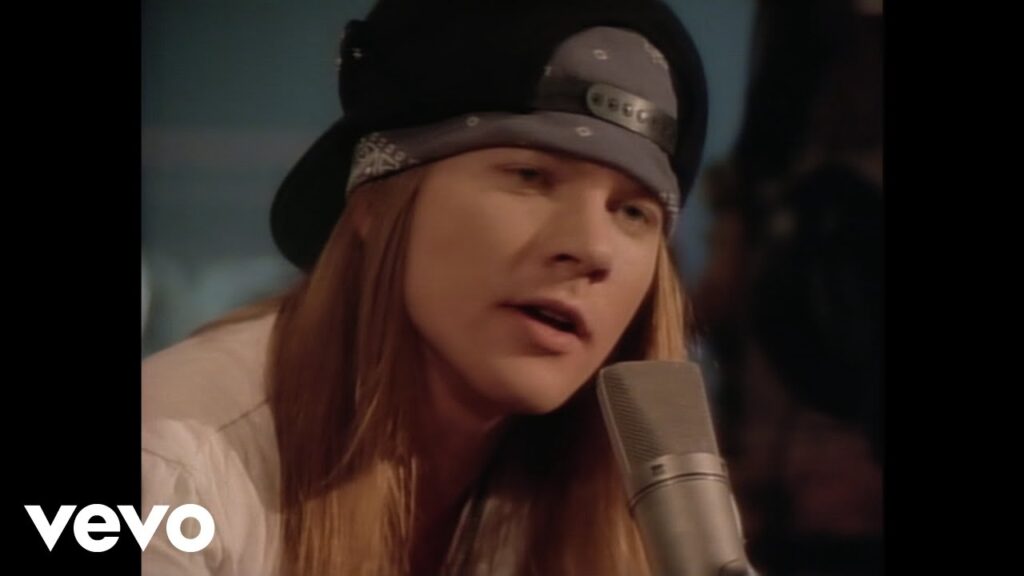
When most people think of Guns N’ Roses, they picture blistering guitar solos, explosive performances, and hard-rock anthems like “Welcome to the Jungle,” “Paradise City,” and “Sweet Child o’ Mine.” Yet one of the band’s most beloved songs contains no electric guitars, no thunderous drums, and no wall of amplifiers. Instead, “Patience” strips away the bombast, revealing a vulnerable side of the band that surprised fans and critics alike. Released in 1989 as the only single from the acoustic album G N’ R Lies, it became one of the defining power ballads of the late 1980s.
Built around three acoustic guitars and one of Axl Rose’s finest vocal performances, “Patience” demonstrated that Guns N’ Roses could create emotional depth without sacrificing the authenticity that had made them one of rock’s biggest acts. More than three decades later, it remains one of the band’s most enduring songs and one of the finest acoustic ballads in rock history.
The origins of “Patience” date back to a period when Guns N’ Roses were rapidly becoming one of the biggest bands in the world. Their 1987 debut, Appetite for Destruction, had exploded into a global phenomenon, transforming five musicians from the Los Angeles club scene into international superstars. Amid relentless touring and growing fame, the band assembled G N’ R Lies, combining previously released material from the Live ?!@ Like a Suicide* EP with four newly recorded acoustic songs.
“Patience” quickly emerged as the standout track. Written primarily by the band members collectively, the song reflected the emotional complexity that often lay beneath Guns N’ Roses’ hard-edged image. Rather than focusing on excess or rebellion, it explored the challenges of maintaining a relationship while navigating uncertainty and distance.
From the opening whistle—performed by Axl Rose himself—listeners immediately know they’re hearing something different. That simple melody has become one of the most recognizable introductions in rock music, setting a relaxed and intimate mood before the acoustic guitars enter.
The arrangement is beautifully understated. Slash, Izzy Stradlin, and Duff McKagan each contribute acoustic guitar parts that weave together seamlessly, creating a rich but uncluttered sound. Rather than competing for attention, the instruments complement one another, leaving plenty of space for the vocals to take center stage.
Producer Mike Clink wisely avoids overcomplicating the recording. Every instrument is crisp and natural, preserving the warmth of the acoustic performance. The mix allows each guitar to occupy its own space while maintaining remarkable clarity, a testament to both the musicianship and the production.
Axl Rose delivers one of the finest vocal performances of his career. Instead of relying on the piercing screams and raw aggression that defined many Guns N’ Roses classics, he sings with remarkable restraint. His voice gradually builds in intensity as the song progresses, moving effortlessly from tender vulnerability to soaring emotional release without ever sounding forced.
What makes the performance so compelling is its sincerity. Rose sounds less like a rock star delivering a power ballad and more like someone genuinely wrestling with uncertainty. His emotional honesty gives the song a timeless quality that continues to resonate with listeners experiencing the ups and downs of relationships.
Lyrically, “Patience” explores the difficulties of love tested by time, distance, and misunderstanding. Rather than offering easy answers, the song acknowledges that successful relationships often require perseverance, trust, and emotional maturity. Its message is refreshingly grounded, avoiding melodrama while remaining deeply heartfelt.
The title itself captures the song’s central theme. Sometimes the strongest response isn’t immediate action but the willingness to endure difficult moments while believing that better days lie ahead. That universal message has helped the song remain relevant across generations.
Released as a single in April 1989, “Patience” became another major success for Guns N’ Roses. It reached No. 4 on the Billboard Hot 100 and performed strongly in numerous countries around the world. More importantly, it broadened the band’s audience, proving they were capable of much more than straightforward hard rock.
The music video further reinforced the song’s intimate atmosphere. Rather than emphasizing elaborate production or flashy visuals, it presents candid moments of the band traveling, performing, and spending time together. Black-and-white cinematography gives the video a reflective quality that perfectly complements the song’s emotional tone.
“Patience” also showcased the chemistry between Guns N’ Roses at their creative peak. Slash’s tasteful acoustic playing, Izzy Stradlin’s understated rhythm work, Duff McKagan’s musical contributions, Steven Adler’s restrained percussion, and Axl Rose’s unforgettable vocal performance all combine to create a recording where every member serves the song rather than individual egos.
Over the years, “Patience” has become one of the band’s most frequently requested concert performances. Live audiences often sing every word, transforming the quiet ballad into one of the most powerful communal moments in a Guns N’ Roses show. The song’s emotional honesty allows it to connect just as strongly in stadiums as it does through headphones.
Its influence extends beyond Guns N’ Roses themselves. “Patience” demonstrated that hard rock bands could successfully embrace acoustic arrangements without compromising their identity. Many rock groups throughout the late 1980s and early 1990s followed a similar path, releasing stripped-down ballads that showcased a more vulnerable side of their music.
Today, “Patience” stands as one of the defining acoustic rock songs of its era. It remains a favorite on classic rock radio, streaming playlists, and live setlists because its emotional core has never gone out of style. While Guns N’ Roses will always be remembered for their electrifying riffs and explosive performances, this quiet masterpiece reminds listeners that true strength often comes through vulnerability rather than volume.
More than thirty-five years after its release, “Patience” continues to resonate because it captures a universal truth. Relationships, dreams, and personal growth rarely happen overnight. Sometimes the most courageous thing a person can do is simply keep believing, keep waiting, and trust that time can heal what seems impossible. In giving that message such a beautiful musical setting, Guns N’ Roses created not only one of their finest songs but one of the greatest acoustic ballads in rock history.
This post has already been read 78 times!