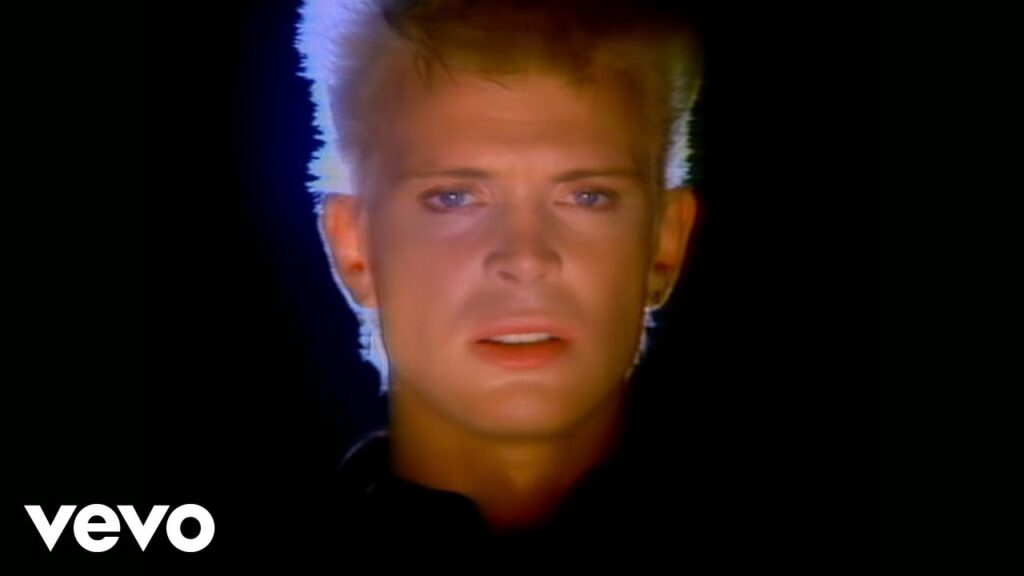
Billy Idol spent much of the 1980s cultivating the image of rock’s ultimate bad boy. With his trademark sneer, leather jackets, platinum-blond spikes, and boundless confidence, he became one of MTV’s defining stars. Songs like “White Wedding,” “Rebel Yell,” and “Dancing with Myself” were loud, energetic, and unapologetically rebellious. Then, in 1984, Idol surprised nearly everyone with “Eyes Without a Face.”
Instead of roaring guitars and arena-ready choruses, listeners were treated to a brooding, atmospheric ballad filled with mystery, regret, and emotional vulnerability. It was unlike anything else dominating rock radio at the time, yet it became one of Idol’s biggest hits and demonstrated that beneath the swagger was an artist capable of remarkable depth.
More than forty years later, “Eyes Without a Face” remains one of the most distinctive and compelling songs of the MTV generation.
A New Direction on Rebel Yell
Following the success of his self-titled debut album, Billy Idol returned in 1983 with Rebel Yell, an album that would transform him into an international superstar.
Packed with energetic rock songs and unforgettable hooks, the record showcased Idol at the peak of his commercial powers.
Yet nestled among the high-octane anthems was “Eyes Without a Face,” a song that slowed everything down and explored a far more introspective side of his songwriting.
Its placement on the album highlighted Idol’s versatility.
He wasn’t content being known only for fist-pumping rock songs.
Inspired by Classic Cinema
The title “Eyes Without a Face” comes from the 1960 French horror film Les Yeux sans visage (“Eyes Without a Face”).
Although the song isn’t a retelling of the movie, the title evokes themes of identity, emotional distance, and hidden pain.
That cinematic inspiration gives the recording an added layer of intrigue.
Even listeners unfamiliar with the film sense that something deeper lies beneath the polished production.
The title alone sparks curiosity.
Billy Idol’s Most Nuanced Vocal
Billy Idol built his reputation on attitude and power, but “Eyes Without a Face” required something entirely different.
His vocal performance is restrained, thoughtful, and filled with melancholy.
Rather than attacking every line, Idol allows the emotion to develop gradually, creating a sense of quiet heartbreak.
When the song finally shifts into its more energetic closing section, the release feels completely earned.
It’s one of the finest vocal performances of his career because it succeeds through subtlety rather than force.
Steve Stevens’ Brilliant Guitar Work
No discussion of Billy Idol’s music is complete without recognizing guitarist Steve Stevens.
Throughout the 1980s, Stevens established himself as one of rock’s most inventive players, blending technical brilliance with an unmistakable melodic style.
On “Eyes Without a Face,” he exercises remarkable restraint for much of the song.
His tasteful guitar textures complement the synthesizers rather than overpowering them.
Then, during the dramatic closing section, Stevens unleashes a fiery solo that provides the emotional climax of the recording.
It’s a perfect example of knowing exactly when to hold back and when to let loose.
A Rich, Atmospheric Production
Producer Keith Forsey crafted a recording that feels both intimate and expansive.
Layered synthesizers create an almost dreamlike backdrop, while subtle percussion and carefully placed guitar parts gradually build tension throughout the song.
Backing vocals from Perri Lister add an ethereal quality that enhances the mysterious atmosphere.
Every production choice serves the song’s emotional arc.
Nothing feels accidental.
The arrangement rewards repeated listening because new details continue revealing themselves.
A Major Commercial Success
Released as the second single from Rebel Yell, “Eyes Without a Face” became Billy Idol’s first Top 10 hit in the United States, reaching No. 4 on the Billboard Hot 100.
The song also performed well internationally, introducing Idol to listeners who may have overlooked his harder-edged rock material.
Its success proved he could thrive outside the boundaries of straightforward rock anthems.
The gamble had paid off spectacularly.
MTV’s Perfect Match
The accompanying music video became another staple of MTV during the network’s golden years.
Filled with surreal imagery, dramatic lighting, and Idol’s unmistakable charisma, the video perfectly complemented the song’s haunting mood.
Unlike many performance videos of the era, it embraced mystery rather than straightforward storytelling.
Its artistic presentation helped reinforce Billy Idol’s reputation as one of MTV’s most visually compelling performers.
For millions of fans, the song and its video became inseparable.
A Song That Defies Easy Labels
One reason “Eyes Without a Face” has endured is its refusal to fit neatly into a single genre.
It blends rock, synth-pop, new wave, and atmospheric balladry into something uniquely its own.
The electronic textures never diminish the emotional weight of the guitars, while the rock elements never overshadow the song’s delicate mood.
That careful balance gives the recording a timeless quality.
It sounds unmistakably like the 1980s while remaining remarkably fresh today.
Billy Idol’s Artistic Growth
Although Billy Idol will always be remembered for his rebellious image, “Eyes Without a Face” revealed a songwriter willing to explore vulnerability and emotional complexity.
It broadened public perception of what he could accomplish as an artist.
Rather than relying solely on attitude, he demonstrated a willingness to take creative risks.
That willingness helped separate him from many of his contemporaries.
The song remains one of the strongest examples of his artistic ambition.
Why It Still Resonates
Some songs become nostalgic favorites simply because they remind listeners of a particular era.
“Eyes Without a Face” goes beyond nostalgia.
Its haunting melody, layered production, emotional vocal performance, and unforgettable guitar work create an experience that feels timeless.
Listeners continue discovering the song because it rewards careful attention.
Each listen reveals another subtle musical detail or emotional nuance.
That’s the hallmark of truly exceptional songwriting.
Final Thoughts
Billy Idol built his career on explosive rock songs, but “Eyes Without a Face” demonstrated that he could be just as compelling when he slowed things down. With a haunting melody, sophisticated production, Steve Stevens’ extraordinary guitar work, and one of Idol’s finest vocal performances, the song became an unforgettable highlight of both Rebel Yell and the entire decade.
More than forty years after its release, “Eyes Without a Face” remains one of Billy Idol’s greatest achievements. Moody, elegant, and emotionally rich, it stands as proof that sometimes an artist’s boldest statement isn’t made by turning up the volume—but by revealing a side of themselves that listeners never expected to hear.
This post has already been read 76 times!