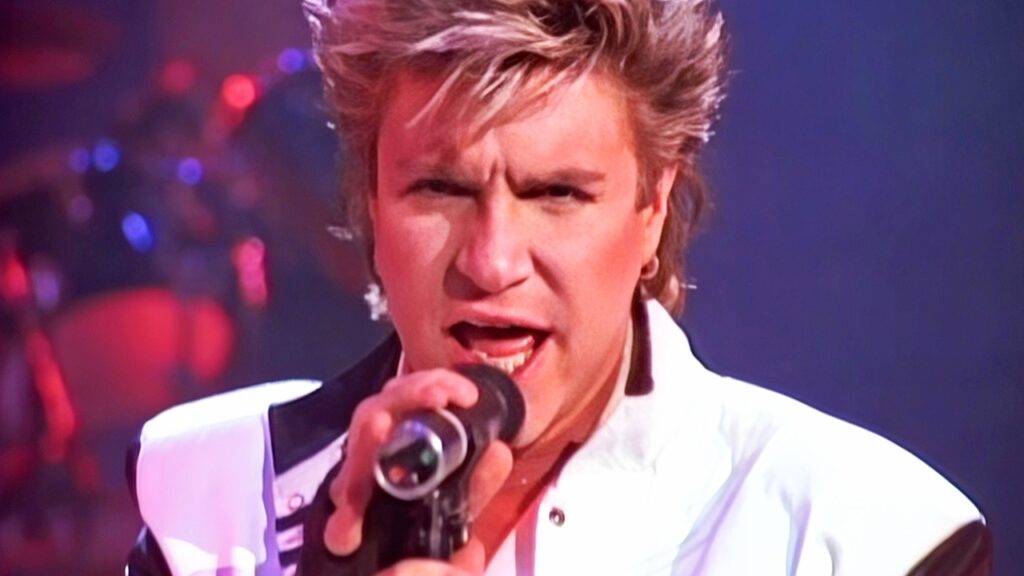
Released in 1984 as the third single from Seven and the Ragged Tiger, “The Reflex” became the biggest hit of Duran Duran’s career. Already one of the world’s most successful bands thanks to songs like “Hungry Like the Wolf,” “Rio,” and “Is There Something I Should Know?,” the group reached an even higher level of popularity when “The Reflex” topped charts around the globe.
The song also marked the beginning of Duran Duran’s collaboration with producer Nile Rodgers, whose remix dramatically reshaped the original album version into the energetic single that listeners came to know. Rodgers’ creative approach added funk-inspired rhythms and innovative production techniques while preserving the band’s unmistakable new wave identity.
The result was a chart-topping classic that remains one of the defining songs of both Duran Duran and the 1980s.
Song Overview
“The Reflex” is one of those songs whose emotional impact comes more from its energy and atmosphere than from a straightforward narrative.
The lyrics hint at temptation, impulsive behavior, and internal conflict without providing clear explanations. Simon Le Bon has often acknowledged that the song’s meaning is intentionally abstract, allowing listeners to interpret it in their own way.
That ambiguity has become one of its greatest strengths.
Rather than spelling everything out, the song creates an emotional mood built around confidence, excitement, and unpredictability.
Combined with its infectious groove, the mystery only adds to its appeal.
Songwriting
Written by all five members of Duran Duran, “The Reflex” showcases the band’s remarkable ability to blend complex arrangements with irresistible pop hooks.
The verses create rhythmic tension before exploding into one of the most recognizable choruses of the decade. The constantly shifting dynamics keep the song exciting from beginning to end.
Unlike many pop songs built around repetition alone, “The Reflex” continually introduces new musical textures and rhythmic ideas without losing its accessibility.
It’s adventurous songwriting disguised as mainstream pop.
Performance
Simon Le Bon delivers one of his strongest vocal performances.
His energetic delivery matches the restless nature of the music, balancing melodic phrasing with confident attitude. He never sounds overwhelmed despite the song’s constantly shifting arrangement.
The rest of the band performs brilliantly.
John Taylor’s bass playing anchors the groove with remarkable precision, while Nick Rhodes layers shimmering synthesizers throughout the recording. Andy Taylor contributes sharp, funky guitar work, and Roger Taylor’s drumming keeps everything moving with relentless energy.
The chemistry between the five members is evident in every section.
Production
The single version, produced and remixed by Nile Rodgers, is a masterpiece of 1980s pop production.
Rodgers transformed the original recording by tightening the rhythm, emphasizing the groove, and introducing creative edits and effects that made the song explode from the speakers.
The mix balances guitars, synthesizers, bass, percussion, and layered vocals without ever becoming cluttered.
Every element serves the song’s momentum.
Even decades later, the production still sounds inventive and exciting.
It’s one of the reasons “The Reflex” has aged far better than many of its contemporaries.
Standout Moments
Several elements make “The Reflex” unforgettable:
- Nile Rodgers’ brilliant remix and production.
- Simon Le Bon’s charismatic vocal performance.
- John Taylor’s outstanding bass work.
- One of the catchiest choruses of the decade.
- Bold, adventurous arrangements filled with creative studio techniques.
The explosive transition into the chorus remains one of the most thrilling moments in 1980s pop music.
It never loses its impact.
Weak Points
There are surprisingly few weaknesses.
Some listeners find the lyrics difficult to interpret, preferring songs with a more direct narrative.
Others may consider the production busy compared to Duran Duran’s earlier work on Rio.
However, those qualities are largely intentional.
The song thrives on its unpredictability and layered complexity.
Its willingness to take creative risks is exactly what separates it from ordinary pop music.
Legacy
“The Reflex” became Duran Duran’s first No. 1 hit on the Billboard Hot 100 and also topped the charts in the United Kingdom and numerous other countries. It helped Seven and the Ragged Tiger become another multi-platinum success and cemented the band’s status as one of the biggest acts of the MTV generation.
The song also demonstrated the enormous influence of Nile Rodgers as a producer and remixer. His work on “The Reflex” helped redefine how remixes could transform a song into a commercial blockbuster, influencing countless pop productions throughout the remainder of the decade.
Today, “The Reflex” remains one of Duran Duran’s signature recordings, appearing regularly on classic hits radio, streaming playlists, and lists of the greatest songs of the 1980s. It perfectly captures the band’s blend of style, musicianship, innovation, and infectious pop craftsmanship.
Final Score
10/10
“The Reflex” is a dazzling pop masterpiece that showcases Duran Duran operating at the height of their creative and commercial powers. Combining adventurous songwriting, outstanding musicianship, Simon Le Bon’s charismatic vocals, and Nile Rodgers’ groundbreaking production, the song remains one of the defining recordings of the 1980s. Bold, mysterious, endlessly catchy, and bursting with energy, “The Reflex” isn’t just one of Duran Duran’s greatest songs—it’s one of the finest pop singles ever recorded.
This post has already been read 81 times!