During the summer of 1989, few movies generated more excitement than Tim Burton’s Batman. Anticipation for the film reached extraordinary levels, with fans eager to see a darker interpretation of the iconic comic book hero. Alongside the movie came an equally ambitious soundtrack, entrusted almost entirely to one artist: Prince. Rather than simply contributing a single song, Prince created an entire album inspired by the film’s characters and atmosphere. Among its standout tracks was “Batdance,” a wildly inventive recording that defied categorization and became one of the most unusual No. 1 hits of the decade.
Combining rock, funk, hip-hop, electronic music, spoken dialogue from the film, and dazzling studio experimentation, “Batdance” captured Prince at his most fearless. It wasn’t merely a soundtrack song—it was a musical collage that reflected the chaos, excitement, and theatricality of Gotham City itself. More than thirty-five years later, it remains one of the boldest singles ever to top the Billboard Hot 100.
Prince entered the Batman project at one of the most creative periods of his career. Already established as one of popular music’s greatest innovators through albums like 1999, Purple Rain, Sign o’ the Times, and Lovesexy, he was known for constantly reinventing himself. Warner Bros. initially envisioned only a few songs for the film, but director Tim Burton became so impressed with Prince’s work that the project expanded into a full soundtrack album.
Rather than writing songs that simply described scenes from the movie, Prince immersed himself in the personalities of Batman, Bruce Wayne, the Joker, and Vicki Vale. He viewed the characters as emotional and psychological inspirations, allowing him to explore themes of duality, identity, madness, and conflict.
“Batdance” became the album’s explosive centerpiece, serving as both a celebration of the film and a showcase for Prince’s limitless imagination.
From the opening seconds, “Batdance” announces that listeners are in for something completely different. The song begins with sampled dialogue from the movie before launching into an unpredictable series of musical transformations. Funk grooves collide with distorted guitar riffs, electronic beats, scratching, horn stabs, orchestral flourishes, and rapid-fire rhythm changes.
Unlike traditional pop songs built around repeating verses and choruses, “Batdance” constantly evolves. New sections appear without warning, styles shift dramatically, and familiar themes are reintroduced in unexpected ways. The recording feels almost cinematic, mirroring the action-packed pace of Burton’s film.
Prince performed nearly every instrument himself, demonstrating once again why he remains one of the most gifted multi-instrumentalists in popular music history. His guitar work alternates between sharp funk rhythms and explosive rock leads, while his keyboard programming creates an energetic blend of electronic textures that still sounds adventurous decades later.
The production is remarkably dense yet surprisingly clear. Despite the enormous number of musical ideas packed into the recording, every element finds its place within the mix. Prince’s meticulous attention to detail allows listeners to discover something new with nearly every replay.
Vocally, “Batdance” highlights Prince’s remarkable versatility. Throughout the song he shifts effortlessly between soulful singing, energetic shouting, falsetto passages, rhythmic spoken delivery, and playful character voices. Rather than maintaining a single vocal persona, he becomes multiple personalities within the same recording.
The inclusion of dialogue from Jack Nicholson’s Joker and Michael Keaton’s Batman further blurs the line between soundtrack and standalone single. These spoken segments aren’t mere promotional additions—they function as integral parts of the musical arrangement, reinforcing the song’s dramatic tension and playful unpredictability.
Prince’s performance captures both the heroic confidence associated with Batman and the manic energy of the Joker, reflecting the central conflict of Burton’s film. Few artists possessed the theatrical instincts necessary to make such an ambitious concept work so convincingly.
Lyrically, “Batdance” doesn’t attempt to retell the movie’s plot. Instead, it embraces the larger themes surrounding its characters. The song explores opposing forces, shifting identities, and the tension between order and chaos. Those ideas mirror the relationship between Batman and the Joker while also fitting comfortably within Prince’s long-standing fascination with duality and self-expression.
The title itself reflects this playful approach. Rather than presenting Batman as a solemn superhero, Prince imagines a frenetic musical celebration inspired by Gotham’s strange world. The result is simultaneously serious, humorous, mysterious, and exhilarating.
Released as the lead single from the Batman soundtrack in June 1989, “Batdance” quickly climbed the charts. It reached No. 1 on the Billboard Hot 100, becoming Prince’s fifth chart-topping single in the United States. The song also achieved strong international success, performing well across Europe, Canada, Australia, and several other markets.
Its popularity helped propel the Batman soundtrack to multi-platinum sales while further expanding Prince’s already remarkable commercial success. The soundtrack itself demonstrated that movie tie-in albums could be ambitious artistic statements rather than simple collections of promotional songs.
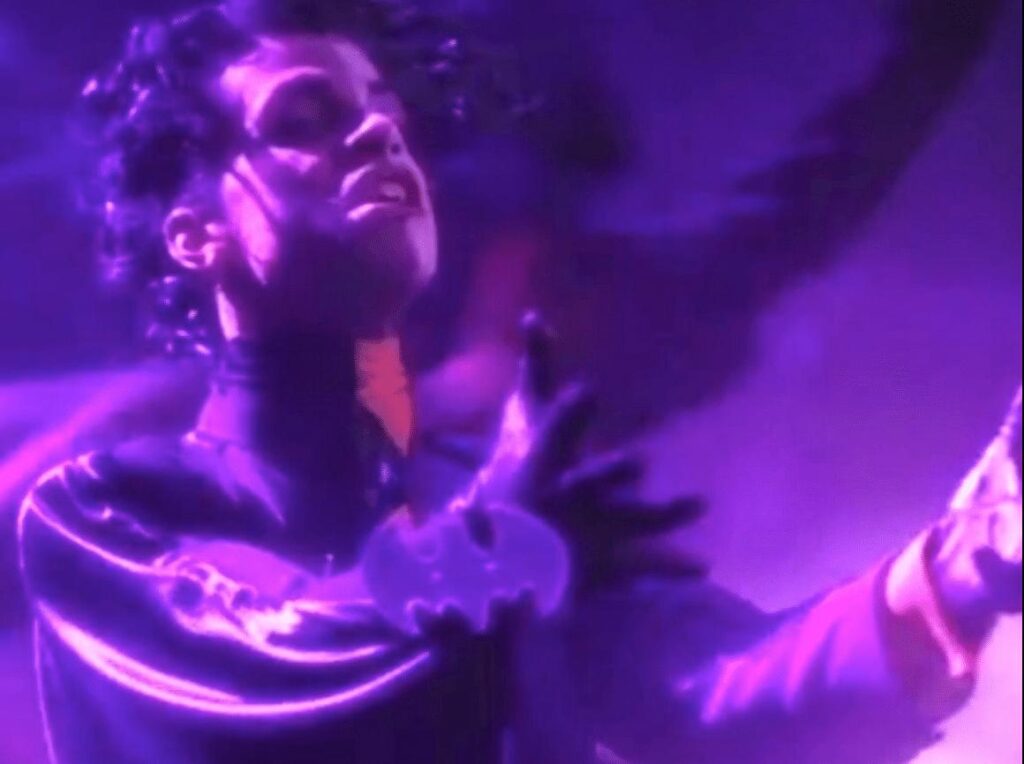
The music video became one of MTV’s most memorable clips of 1989. Prince appeared in elaborate costumes inspired by both Batman and the Joker, dancing in front of dramatic backdrops while rapid editing matched the song’s constantly shifting structure. The video’s striking visuals perfectly complemented Burton’s gothic interpretation of Gotham City and showcased Prince’s flair for theatrical performance.
Although some critics initially found “Batdance” bewildering, appreciation for its originality has grown steadily over the years. The song now stands as one of Prince’s most adventurous mainstream hits, illustrating his willingness to ignore conventional songwriting rules in pursuit of something entirely unique.
Its influence can be heard in later artists who embraced genre-blending production and collage-style arrangements. Long before streaming playlists normalized musical cross-pollination, Prince was seamlessly combining funk, rock, hip-hop, electronic music, and cinematic storytelling within a single recording.
The song also occupies an important place in superhero movie history. Modern comic book films frequently feature carefully curated soundtracks, but few have produced a signature single as distinctive or culturally significant as “Batdance.” It remains closely associated with Burton’s groundbreaking film and represents one of the most successful collaborations between a major recording artist and a blockbuster movie.
Today, “Batdance” stands as one of the boldest entries in Prince’s extraordinary catalog. It challenged expectations, ignored genre boundaries, and transformed what could have been a routine soundtrack single into an unforgettable pop event. Its fearless experimentation demonstrated that commercial success and artistic risk-taking could exist side by side.
More than three decades after its release, “Batdance” continues to surprise new listeners with its creativity and energy. It serves as a reminder that Prince was never content to follow established formulas. Whether writing a heartfelt ballad, a stripped-down funk groove, or an explosive musical adventure inspired by Batman, he consistently found ways to push popular music into exciting new territory. “Batdance” remains one of his most imaginative achievements—a thrilling collision of music, film, and fearless innovation that still sounds unlike anything else on the radio.
This post has already been read 74 times!