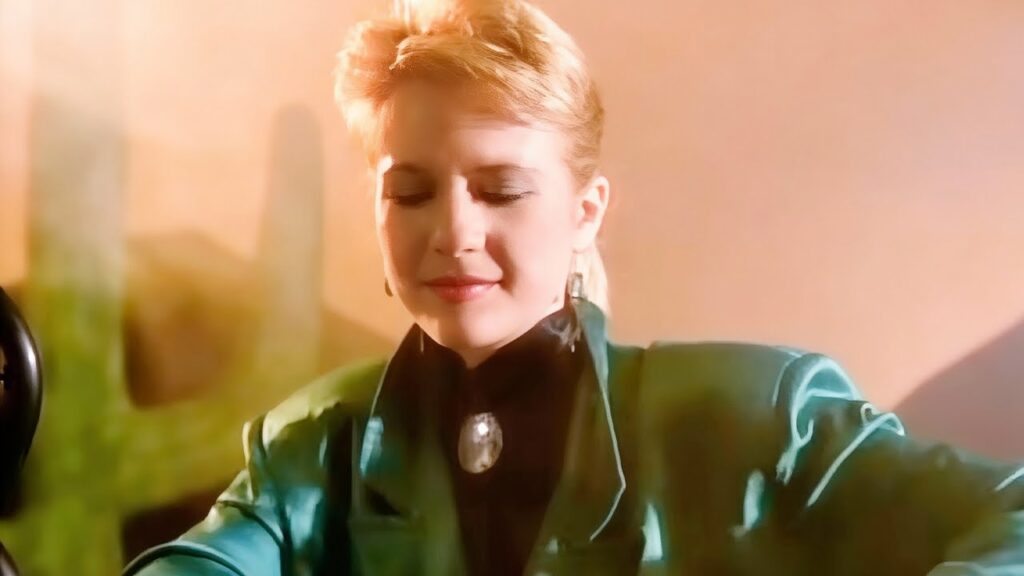
Released in 1985 and becoming a worldwide hit in 1986, “I Can’t Wait” transformed Nu Shooz from a little-known Portland, Oregon duo into international pop stars. Originally issued independently after major record labels showed little interest, the song gained momentum through club play and radio stations before attracting the attention of Atlantic Records, which re-released it nationally.
The gamble paid off spectacularly. “I Can’t Wait” climbed to No. 3 on the Billboard Hot 100 and became one of the defining dance-pop songs of the decade. Combining sleek synthesizers, funk-inspired rhythms, and Valerie Day’s effortlessly cool vocals, the song captured everything that made mid-1980s pop so irresistible.
Decades later, it remains a favorite on ’80s playlists, dance compilations, and classic pop radio, standing as one of the era’s most recognizable one-hit wonders.
Song Overview
“I Can’t Wait” is built around the excitement and anticipation that come with romantic attraction.
Rather than dwelling on uncertainty or heartbreak, the song celebrates the exhilarating feeling of wanting to be with someone while eagerly waiting for the relationship to move forward.
Its emotional simplicity works to its advantage.
The lyrics leave plenty of room for the music to carry the mood, allowing the infectious groove to become the song’s defining feature.
The result is a recording that feels playful, confident, and impossible to resist.
Songwriting
Written by John Smith and Valerie Day, “I Can’t Wait” succeeds through economy and precision.
The verses are concise, quickly leading listeners toward one of the catchiest choruses of the decade. Every melodic phrase feels designed to maximize momentum without becoming repetitive.
The songwriting wisely avoids unnecessary complexity.
Instead, it focuses on memorable hooks, rhythmic phrasing, and a chorus that immediately invites listeners to sing along.
Sometimes the simplest songs are the hardest to write well.
“I Can’t Wait” is proof of that.
Performance
Valerie Day delivers an outstanding vocal performance.
Her voice is smooth, confident, and refreshingly understated. Rather than overpowering the arrangement, she rides the groove with effortless style, allowing the rhythm to remain the song’s driving force.
John Smith’s keyboards, programming, and production create a sophisticated musical backdrop filled with energy and personality.
The musicianship throughout is remarkably tight.
Every instrument—from the punchy bass lines to the crisp percussion and shimmering synthesizers—locks together with precision, creating one of the most danceable recordings of the decade.
Production
Produced by John Smith and Rick Waritz, “I Can’t Wait” is a showcase for polished mid-1980s dance-pop production.
Bright synthesizers, electronic percussion, funky bass lines, tasteful guitar accents, and layered vocal harmonies combine to create a sound that remains instantly recognizable.
Despite its electronic foundation, the recording never feels mechanical.
The groove breathes naturally, giving the song warmth that many synth-heavy productions of the era lacked.
The balance between pop accessibility and dance-floor energy is nearly perfect.
Standout Moments
Several elements make “I Can’t Wait” unforgettable:
- Valerie Day’s effortlessly cool vocal performance.
- One of the catchiest dance-pop grooves of the 1980s.
- Excellent synth and keyboard arrangements.
- A chorus that remains instantly recognizable.
- Crisp, polished production that has aged remarkably well.
The opening instrumental hook immediately grabs the listener.
Within seconds, it’s obvious exactly what song is playing—a hallmark of truly great pop production.
Weak Points
There are very few significant criticisms.
Some listeners may find the lyrics relatively lightweight compared to more emotionally complex pop songs from the same era.
Others may feel the song relies more heavily on groove than dramatic musical development.
Neither criticism significantly affects its success.
“I Can’t Wait” never pretends to be anything other than an irresistibly fun dance-pop record.
It accomplishes that goal brilliantly.
Legacy
“I Can’t Wait” became Nu Shooz’s biggest and most enduring hit, reaching No. 3 on the Billboard Hot 100 and becoming a major success on dance charts around the world. Its remarkable journey from an independently released single to an international smash remains one of the more inspiring success stories of the decade.
Although Nu Shooz never matched the commercial impact of “I Can’t Wait,” the song has enjoyed an enduring afterlife through film soundtracks, television, commercials, streaming playlists, and frequent airplay on classic hits and ’80s radio. It has also been sampled and referenced by numerous artists, further cementing its influence on pop and dance music.
Today, “I Can’t Wait” stands as one of the definitive dance-pop recordings of the 1980s—a sparkling example of how infectious grooves, memorable hooks, and confident performances can create a song that never goes out of style.
Final Score
9.5/10
“I Can’t Wait” is a near-perfect slice of 1980s dance-pop. Valerie Day’s effortlessly stylish vocal, Nu Shooz’s impeccable songwriting, irresistible groove, and polished production combine to create one of the decade’s most enduring pop singles. Fun, sophisticated, and endlessly replayable, it remains a shining example of synth-driven pop at its very best and a song that still fills dance floors nearly forty years after its release.
This post has already been read 123 times!