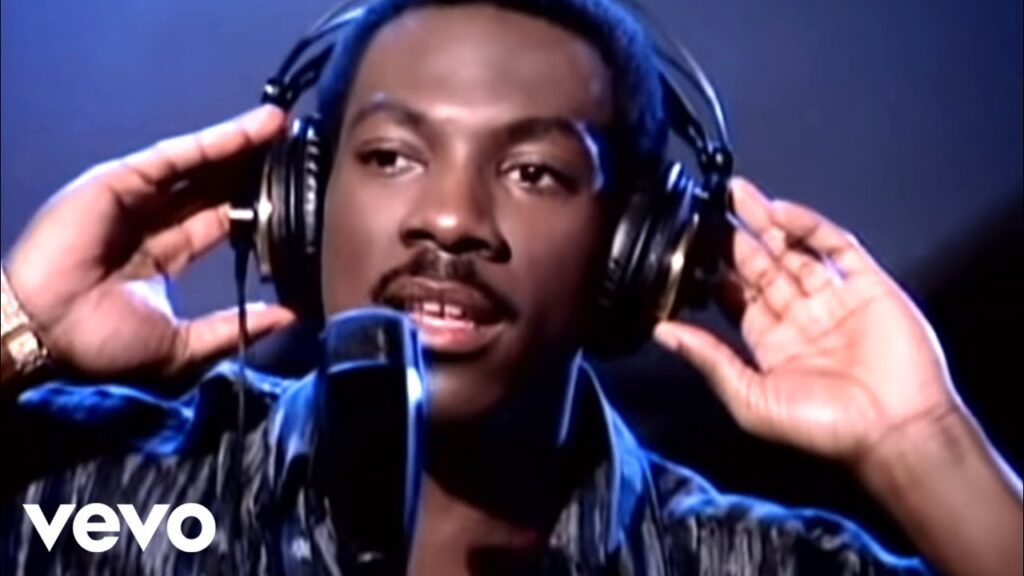
Released in September 1985 as the lead single from Eddie Murphy’s debut album How Could It Be, “Party All the Time” surprised critics, delighted audiences, and became one of the most unexpected pop hits of the decade. Produced by Rick James and featuring a polished blend of synth-pop, R&B, and dance music, the song climbed to No. 2 on the Billboard Hot 100, proving that Murphy’s talents extended well beyond comedy and acting. While some initially viewed the single as a novelty, its infectious hook, glossy production, and undeniable catchiness have allowed it to endure as one of the most recognizable songs of the 1980s.
Today, “Party All the Time” enjoys a second life as both a nostalgic favorite and a pop culture icon, embraced by listeners who appreciate its fun-loving spirit and memorable melody.
Hollywood’s Biggest Star Takes on Music
By 1985, Eddie Murphy was one of the biggest entertainers in the world.
After becoming a breakout star on Saturday Night Live, Murphy quickly dominated the box office with films like 48 Hrs., Trading Places, and Beverly Hills Cop. His stand-up specials had also become massive successes, making him one of the most recognizable celebrities of the decade.
Music wasn’t simply a publicity stunt.
Murphy had long been interested in singing and songwriting, and he wanted to prove he could be taken seriously as a recording artist.
Partnering with Rick James gave the project instant credibility.
Rick James Behind the Controls
Rick James didn’t just produce “Party All the Time”—he fully embraced the project.
Already known for hits like “Super Freak” and “Give It to Me Baby,” James recognized Murphy’s enthusiasm and worked to create a polished pop record that highlighted his strengths rather than treating the song as a joke.
His influence is heard throughout the recording.
The driving bass line, shimmering synthesizers, crisp drum programming, and layered harmonies all reflect James’ signature blend of funk and mainstream pop.
The result sounds unmistakably like a mid-1980s Rick James production.
A Story of Romantic Frustration
Despite its upbeat title, “Party All the Time” isn’t simply a dance song.
The lyrics tell the story of someone struggling with a relationship in which his girlfriend seems more interested in going out than spending time together. The narrator repeatedly expresses confusion and frustration as he wonders why she constantly chooses nightlife over their romance.
The theme is simple and easy to follow.
Rather than becoming overly dramatic, the song approaches the situation with playful energy, making it just as enjoyable on the dance floor as it is through headphones.
Eddie Murphy’s Surprisingly Strong Vocal
One of the biggest surprises for first-time listeners is Murphy’s singing ability.
While he isn’t attempting to compete with powerhouse vocalists, he delivers the song with confidence, enthusiasm, and solid pitch. His relaxed style fits comfortably within Rick James’ production, allowing the melody to remain the focus.
Murphy’s vocal has an appealing sincerity.
Instead of trying to sound like someone else, he embraces his own personality, which gives the performance much of its charm.
His delivery remains one of the song’s strongest assets.
A Perfect Slice of 1980s Production
“Party All the Time” captures nearly everything listeners love about mid-1980s pop.
Bright synthesizers, electronic drums, funky bass, clean guitar accents, and polished background vocals create a sound that is unmistakably of its era. Yet the arrangement avoids becoming cluttered, allowing the memorable chorus to shine.
Rick James understood exactly how to balance pop accessibility with dance-floor energy.
The production remains vibrant and enjoyable decades later.
A Surprise Smash Hit
Many critics expected Murphy’s musical ambitions to be short-lived.
Instead, “Party All the Time” became an enormous commercial success, peaking at No. 2 on the Billboard Hot 100, held out of the top spot only by Lionel Richie’s “Say You, Say Me.” It also charted internationally and became a major club favorite.
The song’s popularity demonstrated that audiences were willing to embrace Murphy as more than just a comedian.
It remains his only major pop hit, but it was a significant one.
Heavy MTV Rotation
The colorful music video received extensive airplay on MTV during late 1985 and early 1986.
Featuring Murphy performing alongside Rick James and a lively cast of dancers, the video reflected the bright, glamorous aesthetic of the era. Murphy looked completely at ease in front of the camera, thanks to his already considerable experience as a performer.
The video’s playful energy perfectly matched the recording.
Its frequent rotation helped introduce the song to millions of viewers.
Why It Has Become a Cult Favorite
Over the years, “Party All the Time” has experienced a remarkable critical reevaluation.
What was once dismissed by some reviewers as a celebrity novelty has increasingly been appreciated for what it actually is: a genuinely well-produced pop song with an unforgettable hook. Younger audiences have also embraced it through movies, television shows, commercials, streaming playlists, and internet memes.
Its sense of fun has never faded.
The song refuses to take itself too seriously, which has become part of its lasting appeal.
Legacy
“Party All the Time” stands as one of the most surprising hit singles of the 1980s and one of the decade’s great pop culture success stories. Eddie Murphy successfully stepped outside the worlds of comedy and film to deliver a recording that remains instantly recognizable, while Rick James supplied the polished production needed to transform the project into a legitimate chart contender.
Although Murphy would ultimately remain best known as an actor and comedian, this song proved he possessed genuine musical ability and the confidence to explore new creative directions. Its catchy chorus, infectious groove, and unmistakable 1980s sound have ensured that it continues to entertain audiences decades after its release.
More than forty years later, “Party All the Time” remains an irresistible blast of MTV-era pop. Fun, energetic, and endlessly catchy, it has earned its place as one of the most memorable crossover hits of the decade and a reminder that sometimes the biggest surprises become the songs people remember the longest.
This post has already been read 84 times!