Some songs impress with dazzling guitar solos. Others rely on elaborate studio production or massive orchestras. Billy Joel’s “The Longest Time” accomplished something entirely different. Using little more than layered voices, finger snaps, a simple rhythm section, and a timeless melody, Joel created one of the most distinctive and beloved songs of the 1980s.
Released in 1984 as a single from An Innocent Man, “The Longest Time” celebrated the golden age of 1950s and early 1960s vocal groups while showcasing Billy Joel’s remarkable versatility as a songwriter. It sounded as though it could have come from another era, yet it fit perfectly alongside the biggest pop hits of the MTV generation.
More than forty years later, it remains one of Joel’s most charming recordings and one of the finest examples of modern doo-wop ever recorded.
Looking Back to the Music He Loved
By the early 1980s, Billy Joel had already established himself as one of America’s greatest singer-songwriters with albums like The Stranger, 52nd Street, and Glass Houses.
Instead of repeating himself, Joel decided to make something completely different.
Released in 1983, An Innocent Man served as a tribute to the music he grew up listening to during the late 1950s and early 1960s.
Rather than copying those styles, Joel celebrated them.
Each song reflected a different influence.
There were nods to Motown.
Soul.
R&B.
Pop.
And with “The Longest Time,” classic doo-wop.
The result felt nostalgic without becoming an imitation.
Inspired by the Great Vocal Groups
“The Longest Time” draws heavily from legendary vocal harmony groups such as Frankie Lymon & The Teenagers, The Four Seasons, Dion and the Belmonts, and The Duprees.
Those artists relied on intricate harmonies instead of complicated instrumentation.
Joel embraced that same philosophy.
The song’s warm background vocals aren’t simply decoration.
They’re the foundation of the entire arrangement.
Listeners immediately feel transported to the street-corner harmonies of an earlier generation.
Yet the songwriting remains unmistakably Billy Joel.
It’s a perfect blend of past and present.
Billy Joel Sang Nearly Every Vocal Part
One of the most impressive facts about “The Longest Time” is that nearly every vocal heard on the recording was sung by Billy Joel himself.
Instead of bringing in a traditional vocal group, Joel painstakingly recorded layer after layer of harmony in the studio.
Each part had to fit perfectly.
Timing.
Pitch.
Blend.
Every detail mattered.
The finished recording creates the illusion of an entire doo-wop ensemble, but it’s largely the work of one remarkably talented musician.
Only the deep bass vocal at the very beginning and end of the song was performed by bassist Doug Stegmeyer.
Everything else came from Billy Joel.
Keeping the Instruments in the Background
Although many listeners think of “The Longest Time” as an entirely a cappella recording, it actually includes a small number of instruments.
There are subtle bass, drums, and percussion parts supporting the vocals.
They’re intentionally understated.
Producer Phil Ramone understood that the voices should remain the stars of the performance.
By resisting the temptation to add unnecessary layers, he allowed the harmonies to shine.
The production remains remarkably clean and uncluttered.
That’s one reason the song still sounds so fresh today.
A Song About Finding Love Again
Lyrically, “The Longest Time” explores the joy of rediscovering hope after believing it had disappeared.
The narrator reflects on unexpectedly finding happiness later in life, realizing that love arrived when it was least expected.
Unlike many romantic songs filled with dramatic declarations, this one feels relaxed and optimistic.
It’s less about infatuation than gratitude.
The emotions are understated.
The confidence is quiet.
That sincerity gives the song lasting emotional appeal.
Listeners of every generation can relate to the idea that life’s best surprises often arrive when we least expect them.
Climbing the Charts
Released as a single in 1984, “The Longest Time” became another major success for Billy Joel.
It reached the Top 20 on the Billboard Hot 100 and performed even better on the Adult Contemporary chart, where its timeless sound found an especially enthusiastic audience.
Internationally, the song became one of Joel’s best-known recordings.
It helped extend the remarkable success of An Innocent Man, which produced an extraordinary string of hit singles including “Tell Her About It,” “Uptown Girl,” and “Keeping the Faith.”
The album proved that looking backward could sometimes produce something refreshingly new.
A Favorite on MTV
Although “The Longest Time” was inspired by music decades older than MTV itself, the song found plenty of success on the young television network.
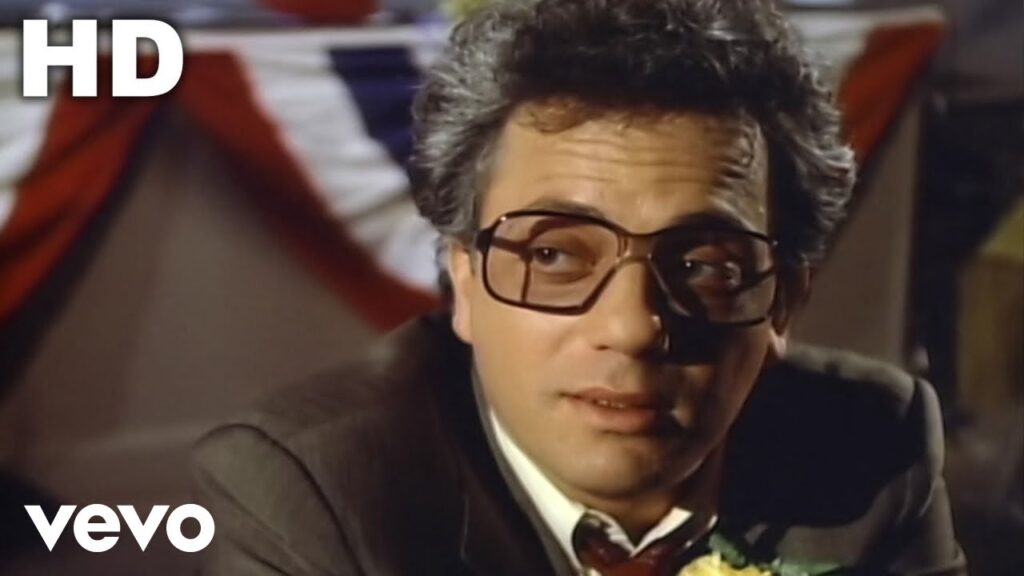
Its music video featured Joel and a group of friends meeting outside what appears to be a neighborhood bar before breaking into song together.
The visual perfectly matched the street-corner atmosphere of the recording.
There were no elaborate special effects.
No complicated storyline.
Just music, friendship, and harmony.
That simplicity complemented the song beautifully.
One of Billy Joel’s Most Difficult Songs to Perform
Because the studio recording relied on so many carefully layered vocal parts, performing “The Longest Time” live presented a unique challenge.
Joel’s touring band had to recreate harmonies that had originally been stacked one voice at a time.
The result required careful coordination and exceptional vocal control.
Even today, the song remains one of the highlights of Billy Joel’s concerts, often inspiring enthusiastic audience sing-alongs.
Its melody practically invites listeners to join in.
A Lasting Influence
“The Longest Time” helped remind audiences that vocal harmony could still thrive during an era dominated by synthesizers and electronic production.
Its success encouraged renewed appreciation for doo-wop and classic harmony singing.
School choirs, barbershop quartets, collegiate a cappella groups, and vocal ensembles have embraced the song for decades.
Its arrangement has become one of the most frequently performed modern harmony pieces.
Very few pop songs enjoy that kind of second life.
Why It Still Sounds Timeless
Many songs from the mid-1980s are immediately recognizable because of their production techniques.
“The Longest Time” largely avoids that trap.
Its emphasis on human voices rather than studio effects gives it a timeless quality.
Great harmonies never go out of style.
Neither do memorable melodies.
Combined with Billy Joel’s effortless songwriting, those qualities have allowed the song to remain every bit as enjoyable today as it was in 1984.
It doesn’t sound old.
It simply sounds classic.
Legacy
“The Longest Time” stands as one of Billy Joel’s most inventive and enduring recordings. By paying tribute to the doo-wop music of his youth while showcasing his extraordinary vocal talents, Joel created a song that bridges generations with effortless charm. Its rich harmonies, heartfelt message, and timeless melody have made it a favorite on radio, at weddings, in school performances, and around campfires for decades. More than forty years after its release, “The Longest Time” remains proof that sometimes the simplest arrangements leave the biggest impression, especially when they’re built on unforgettable songs and exceptional voices.
This post has already been read 108 times!