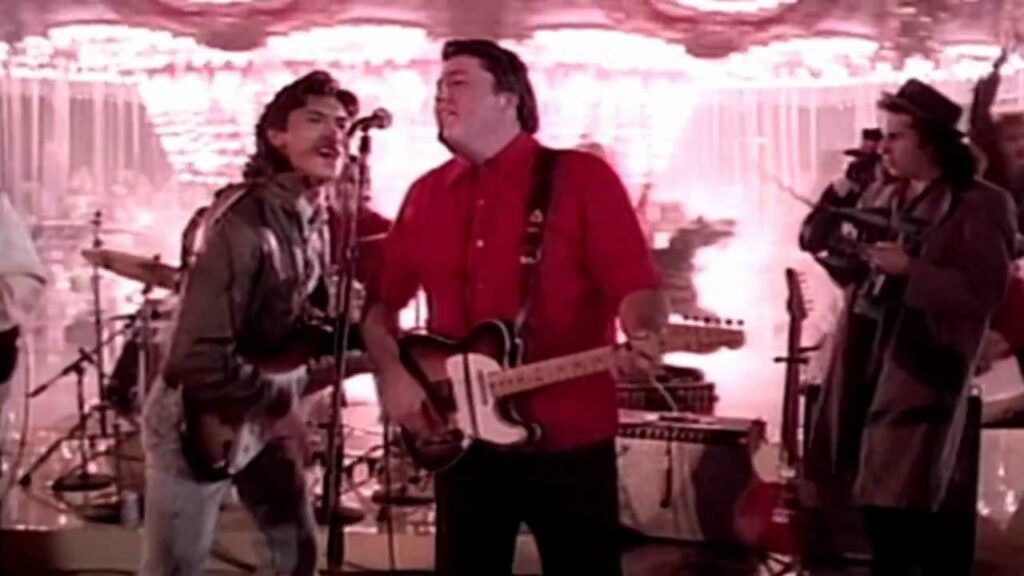
Few songs have traveled a journey quite like “La Bamba.” Long before it became a chart-topping hit for Los Lobos in 1987, it had already lived several musical lives. Rooted in a centuries-old Mexican folk song and immortalized by Ritchie Valens in 1958, “La Bamba” returned to the top of the charts nearly thirty years later thanks to Los Lobos’ vibrant recording for the hit film La Bamba.
The band’s version honored both the song’s traditional origins and Valens’ groundbreaking legacy while introducing it to an entirely new generation. It became one of the rare remakes to equal—and for many listeners, rival—the original in popularity.
More than three decades later, Los Lobos’ “La Bamba” remains one of the most joyful, energetic, and culturally significant recordings of the 1980s.
A Song with Centuries of History
Unlike most pop hits, “La Bamba” wasn’t written by a single songwriter.
Its roots stretch back hundreds of years to the Mexican state of Veracruz, where it developed as a traditional folk song performed during weddings and celebrations. The melody, rhythm, and lyrics evolved over generations, making it part of Mexico’s rich musical heritage.
By the 1950s, a young rock-and-roll musician named Ritchie Valens saw the potential to introduce the song to American audiences.
His electrified version became a groundbreaking crossover hit.
Although Valens’ life ended tragically in the 1959 plane crash that also claimed Buddy Holly and J.P. “The Big Bopper” Richardson, his recording became one of rock and roll’s most enduring classics.
Why Los Lobos Were the Perfect Choice
When producers began making the 1987 biographical film La Bamba, they needed musicians capable of recreating Ritchie Valens’ recordings with authenticity while bringing fresh energy to the soundtrack.
Los Lobos were the obvious choice.
The East Los Angeles band had built a reputation for blending rock, blues, Tex-Mex, country, folk, and traditional Mexican music into a sound unlike anyone else’s.
They respected Valens’ legacy because they understood the cultural importance of his achievements.
Rather than simply copying the original, they infused the songs with their own musicianship while preserving the spirit that made them timeless.
A Performance Full of Joy
From the opening guitar chords, Los Lobos’ version radiates excitement.
The rhythm feels slightly heavier than Valens’ original while maintaining its danceable energy.
The band’s tight musicianship gives every instrument room to shine.
The guitars sparkle.
The percussion drives the momentum.
The vocals sound enthusiastic without becoming overproduced.
Most importantly, the performance feels genuine.
Los Lobos approach the song not as museum curators but as musicians celebrating a tradition they deeply love.
That authenticity comes through in every note.
Honoring Ritchie Valens Without Copying Him
Cover songs often fall into one of two traps.
Some imitate the original so closely that they add nothing new.
Others reinvent the material so completely that its identity disappears.
Los Lobos found the perfect balance.
Their version pays obvious respect to Valens while introducing modern production techniques and a fuller band sound that reflected the musical landscape of the 1980s.
Listeners familiar with the original immediately recognize it.
At the same time, the recording stands comfortably on its own.
That’s a remarkable accomplishment.
A Movie That Touched Millions
The release of La Bamba helped introduce Ritchie Valens’ story to audiences who knew little about his remarkable career.
The film chronicled his rapid rise to fame, his close relationship with his family, and the tragedy that ended his life at just seventeen years old.
Los Lobos’ soundtrack became an essential part of the film’s emotional impact.
Rather than feeling like nostalgic background music, the songs served as the heartbeat of the story.
For many younger viewers, the movie represented their first exposure to Valens’ music.
A Number One Smash
Released as the soundtrack’s lead single, “La Bamba” quickly became an international phenomenon.
It reached No. 1 on the Billboard Hot 100, making Los Lobos the first act to take a predominantly Spanish-language song to the top of the American pop charts.
The recording also became a major hit across Europe, Australia, Canada, and Latin America.
Its success demonstrated that audiences were eager to embrace music that crossed cultural and linguistic boundaries.
The achievement remains one of the most important crossover moments in pop music history.
More Than a Cover Version
Although often described simply as a remake, Los Lobos’ “La Bamba” accomplished something much larger.
It celebrated Mexican musical traditions.
It honored one of rock’s earliest Latino pioneers.
It introduced bilingual music to mainstream pop audiences.
And it reminded listeners that great songs never truly disappear.
Instead, they find new voices.
New audiences.
New moments.
Very few cover songs carry that level of cultural significance.
The Lasting Influence
“La Bamba” continues appearing at weddings, sporting events, festivals, school celebrations, and family gatherings around the world.
Its joyful rhythm makes it nearly impossible to resist.
The song has become a shared cultural experience across generations and national boundaries.
Los Lobos themselves have continued enjoying long, respected careers while remaining one of America’s most admired roots-rock bands.
Yet “La Bamba” remains their signature recording.
For many listeners, it serves as the perfect introduction to the group’s remarkable musical versatility.
A Celebration That Never Stops
More than thirty-five years after topping the charts, Los Lobos’ version of “La Bamba” remains one of the happiest records ever made. Its infectious rhythm, spirited musicianship, and deep respect for musical tradition continue bringing people together regardless of age, language, or background.
The recording proves that great music has no expiration date. By blending centuries-old folk traditions with rock-and-roll energy, Los Lobos created a version that honors the past while feeling completely alive in the present.
For Los Lobos, “La Bamba” became much more than a soundtrack hit. It became a celebration of heritage, a tribute to Ritchie Valens, and one of the most culturally important songs of the 1980s—a joyful reminder that music has always been one of the world’s most powerful universal languages.
This post has already been read 87 times!