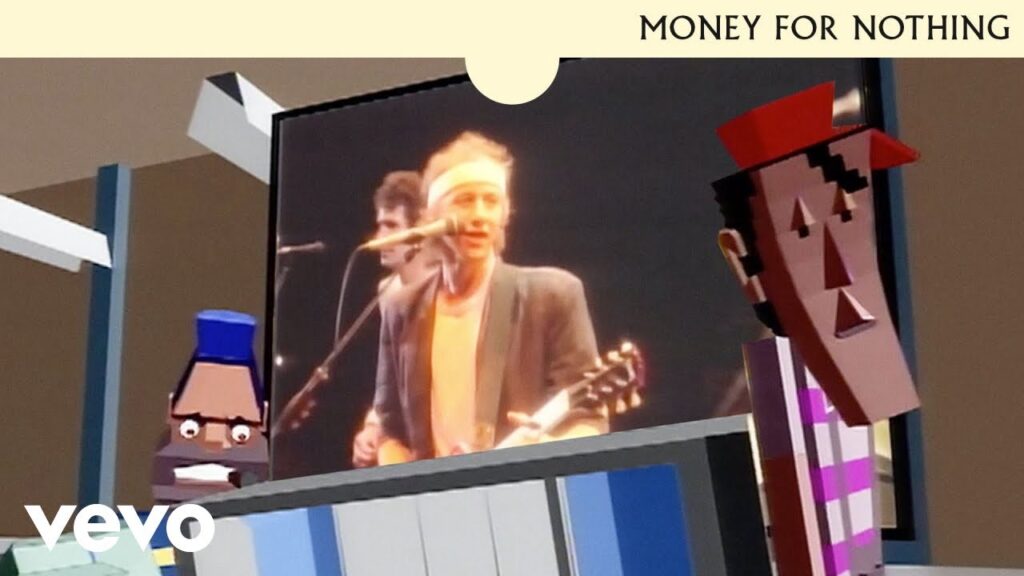
During the mid-1980s, few songs captured the changing landscape of popular music quite like “Money for Nothing.” Released in 1985 as the second single from Dire Straits’ landmark album Brothers in Arms, the song combined blistering guitar work, sharp social commentary, and one of the most recognizable introductions in rock history. It became the band’s biggest international hit, won a Grammy Award, and helped establish Brothers in Arms as one of the best-selling albums ever released.
With Mark Knopfler’s unmistakable guitar tone, an unforgettable guest appearance by Sting, and a music video that pushed the boundaries of computer animation, “Money for Nothing” became much more than a hit single. It was a defining moment for rock music, MTV, and the rapidly evolving world of music videos.
More than forty years later, it remains one of the most iconic recordings of the decade.
Born from an Everyday Conversation
One of the most fascinating aspects of “Money for Nothing” is its unusual inspiration.
Mark Knopfler reportedly overheard an appliance store employee complaining about rock stars while televisions played music videos in the background. The worker’s observations became the foundation for the song’s lyrics, which are delivered from the perspective of someone looking at the glamorous lives of musicians from the outside.
That perspective was key.
The song isn’t celebrating those opinions.
It’s portraying them.
Knopfler’s storytelling allows listeners to observe the character’s assumptions and frustrations without turning them into the song’s own point of view.
It’s a clever example of narrative songwriting.
One of Rock’s Greatest Guitar Riffs
Before a single lyric is sung, “Money for Nothing” announces itself with one of the most powerful guitar intros in rock history.
Mark Knopfler’s distinctive guitar tone has become legendary among musicians, blending warmth, grit, and remarkable clarity into a sound instantly recognizable after just a few notes.
The riff is both simple and unforgettable.
It drives the entire song.
Even listeners unfamiliar with Dire Straits can usually identify it within seconds.
It’s one of the defining guitar moments of the 1980s.
Sting’s Memorable Contribution
The song’s famous opening vocal, performed by Sting, provides another instantly recognizable element.
Its soaring melody serves as a striking introduction before Knopfler’s guitar crashes into the mix.
Although brief, Sting’s appearance adds an extra layer of atmosphere and helped create one of rock’s most memorable openings.
The collaboration between two of the era’s biggest artists felt natural rather than promotional.
It remains one of the most successful guest appearances in rock history.
A Landmark in Production
Produced by Neil Dorfsman and Mark Knopfler, “Money for Nothing” showcases the pristine digital sound that helped define Brothers in Arms.
The recording balances enormous drums, layered guitars, synthesizers, and spacious production without sacrificing musical detail.
Every instrument has room to breathe.
Every dynamic shift feels intentional.
The result is a recording that became an audiophile favorite and remains a popular demonstration track for high-end sound systems.
Few rock songs of its era sound this expansive.
A Music Video That Changed MTV
The groundbreaking computer-animated music video became almost as famous as the song itself.
Featuring stylized digital characters watching MTV and commenting on the performers, the video represented a major technological leap for music television.
At a time when computer animation was still in its infancy, the visuals felt revolutionary.
MTV embraced it immediately.
Audiences couldn’t look away.
The video won numerous awards and helped define the visual identity of the network during its peak years.
A Massive Commercial Success
Released in 1985, “Money for Nothing” reached No. 1 on the Billboard Hot 100 and became Dire Straits’ biggest hit in the United States.
Its success fueled the extraordinary popularity of Brothers in Arms, which went on to sell more than 30 million copies worldwide and became one of the first albums to achieve massive success during the CD era.
The song also earned a Grammy Award for Best Rock Performance by a Duo or Group with Vocal.
It wasn’t simply a hit.
It became a cultural event.
A Song That Sparked Conversation
Over the years, “Money for Nothing” has also generated discussion because some of its lyrics reflect the viewpoint of the fictional appliance-store worker rather than the songwriter himself.
As language and cultural attitudes evolved, certain words in the song became controversial, prompting radio edits and renewed conversations about artistic context and storytelling.
Those discussions have become part of the song’s legacy.
They also highlight how narrative songwriting can sometimes blur the line between a character’s voice and an artist’s own beliefs.
A Lasting Legacy
More than forty years after its release, “Money for Nothing” remains one of Dire Straits’ signature recordings.
Its legendary guitar riff continues to inspire musicians, while its groundbreaking production and innovative video are frequently cited in discussions of the most influential music of the 1980s.
The song appears regularly on lists celebrating the greatest rock recordings ever made.
Its influence extends far beyond classic rock radio.
It helped define an era.
Final Thoughts
“Money for Nothing” stands among the greatest rock songs of the 1980s because it perfectly combines exceptional musicianship, unforgettable songwriting, groundbreaking production, and cultural relevance into one extraordinary recording. Mark Knopfler’s remarkable guitar work, Sting’s memorable guest appearance, and the song’s innovative music video created a phenomenon that extended well beyond the charts.
Its success helped establish Brothers in Arms as one of the most important albums of its generation, but the song’s enduring popularity comes from its remarkable craftsmanship. Every element—from the opening vocal to the closing guitar lines—feels purposeful and unforgettable.
Many rock songs become products of their time.
“Money for Nothing” helped define its time.
That achievement has secured its place as one of the most important and enduring classics in rock history.
This post has already been read 82 times!