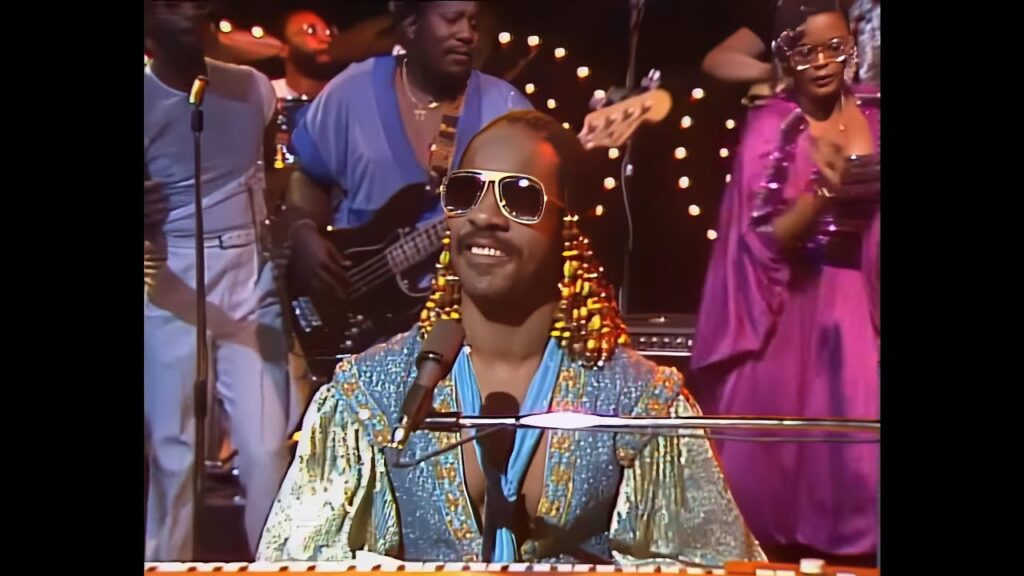
Stevie Wonder’s Joyful Tribute to Bob Marley and the Spirit of Reggae
Released in September 1980 as the lead single from Hotter Than July, “Master Blaster (Jammin’)” became one of Stevie Wonder’s biggest hits of the decade and one of the most successful reggae-inspired songs ever recorded by an American artist. Combining Wonder’s unmistakable vocals, infectious melodies, and a groove rooted in Jamaican reggae, the song celebrated music’s power to unite people while paying heartfelt tribute to Bob Marley and the global influence of reggae.
The single topped the Billboard R&B chart for seven consecutive weeks and reached No. 5 on the Billboard Hot 100, proving once again that Stevie Wonder could seamlessly blend musical styles while creating songs that appealed to audiences around the world.
More than forty years later, “Master Blaster (Jammin’)” remains one of Wonder’s most uplifting recordings and a shining example of his remarkable musical versatility.
A Celebration Rather Than an Imitation
By 1980, Stevie Wonder had already established himself as one of the greatest artists in popular music history. Throughout the 1970s, albums like Talking Book, Innervisions, Fulfillingness’ First Finale, and Songs in the Key of Life had redefined soul, R&B, and pop music.
Rather than repeating familiar formulas, Wonder continually explored new influences.
One of those influences was reggae.
Inspired by Bob Marley and the Wailers, Wonder wanted to honor both the music and the optimistic spirit that reggae represented. Instead of attempting to sound exactly like a Jamaican artist, he blended reggae rhythms with his own distinctive style of soul, funk, pop, and R&B.
The result sounded unmistakably like Stevie Wonder while respectfully celebrating another musical tradition.
Songwriting
“Master Blaster (Jammin’)” is built around optimism.
The lyrics celebrate the idea that music can overcome hardship, bring people together, and provide hope during difficult times.
Wonder references the joy of gathering, dancing, and sharing positive experiences while acknowledging that the world still faces challenges.
The title itself is a nod to Bob Marley, whose influence is felt throughout the recording.
Rather than focusing on politics or conflict, Wonder emphasizes unity and the healing power of music.
That hopeful perspective gives the song timeless appeal.
Its message feels just as meaningful today as it did in 1980.
Stevie Wonder’s Performance
Stevie Wonder delivers one of his warmest and most joyful vocal performances.
His voice radiates genuine happiness from the opening line.
Unlike some of his more emotionally intense recordings, “Master Blaster (Jammin’)” feels relaxed and celebratory.
Wonder’s phrasing effortlessly rides the reggae groove while maintaining the soulful vocal style that defines his music.
His harmonica also makes a memorable appearance, adding another layer of personality to the recording.
Every note reflects the enthusiasm he clearly felt for the music that inspired the song.
Production
Produced by Stevie Wonder himself, the recording perfectly blends reggae rhythms with polished American soul.
The arrangement includes:
- Reggae-inspired guitar rhythms
- Deep bass groove
- Crisp drums
- Warm synthesizers
- Electric piano
- Stevie Wonder’s signature harmonica
The production is spacious and relaxed.
Nothing feels rushed.
Every instrument contributes to the laid-back atmosphere while maintaining enough rhythmic energy to keep listeners moving.
Rather than simply copying reggae conventions, Wonder incorporates his own harmonic richness and melodic sophistication into the arrangement.
Chart Success
“Master Blaster (Jammin’)” became another major success in Stevie Wonder’s extraordinary career.
The song reached:
- No. 5 on the Billboard Hot 100
- No. 1 on the Billboard R&B chart
- Top 10 in the United Kingdom
- Top 10 in Canada
- Strong international chart success
Its commercial success helped Hotter Than July become one of Wonder’s biggest-selling albums and introduced reggae influences to an even broader mainstream audience.
Why It Still Sounds Fresh
A Positive Message
The song celebrates joy, unity, and music’s ability to bring people together.
Those themes never go out of style.
Stevie Wonder’s Incredible Musicianship
Wonder performs with effortless confidence, demonstrating once again why he ranks among music’s greatest multi-instrumentalists.
Respectful Musical Fusion
Instead of imitating reggae, Wonder blends it naturally with his own musical identity.
The result feels authentic and original.
Timeless Groove
The relaxed rhythm remains just as inviting today as it was upon release.
It’s impossible not to move along with the beat.
Cultural Impact
“Master Blaster (Jammin’)” played an important role in introducing reggae influences to wider pop audiences during the early 1980s.
It also strengthened the growing appreciation for Bob Marley’s music beyond Jamaica, helping expose new listeners to reggae’s rich traditions.
The song has appeared in films, television programs, sporting events, and countless playlists celebrating positive, feel-good music.
Its joyful atmosphere continues to make it a favorite at gatherings around the world.
Legacy
Among Stevie Wonder’s extraordinary catalog, “Master Blaster (Jammin’)” stands as one of his most distinctive stylistic experiments.
While he had already mastered soul, funk, pop, and R&B, this recording demonstrated his remarkable ability to embrace another musical tradition without losing his own identity.
It also remains one of the finest tributes one legendary artist has ever paid to another.
Rather than simply honoring Bob Marley with words, Wonder celebrated him through music that embodied the same spirit of optimism and unity.
Final Thoughts
“Master Blaster (Jammin’)” is a joyful reminder of music’s unique ability to connect people across cultures and genres.
Stevie Wonder combined reggae rhythms, soulful vocals, thoughtful songwriting, and outstanding musicianship into a recording that continues to spread positivity more than four decades after its release.
It’s both a loving tribute to Bob Marley and another shining example of Wonder’s extraordinary creativity.
Whenever the groove begins, it’s impossible not to smile.
This post has already been read 77 times!