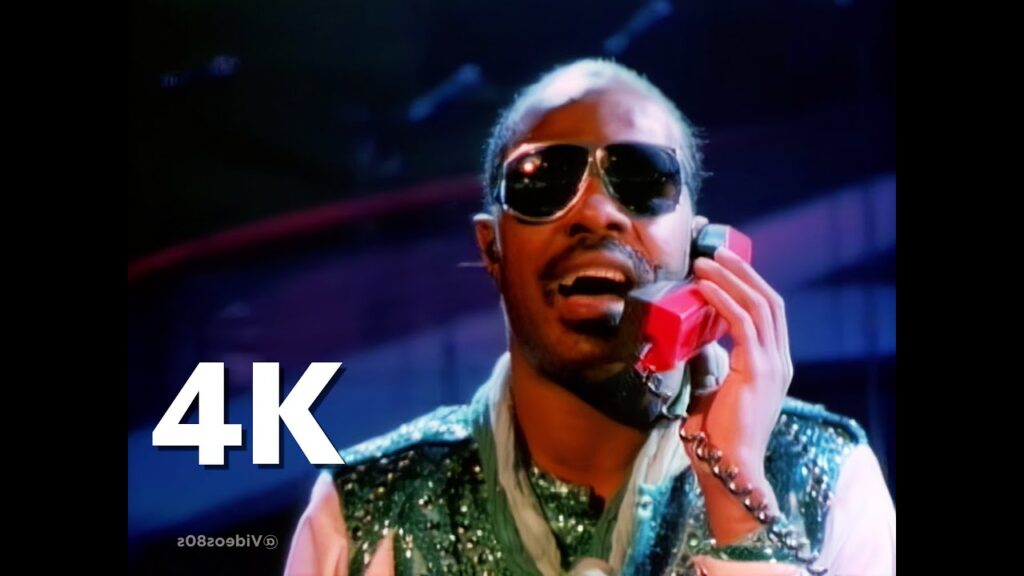
Stevie Wonder spent the 1970s creating some of the most groundbreaking music in popular history. Albums like Innervisions, Songs in the Key of Life, and Talking Book established him as one of the greatest songwriters and musicians of his generation. By the time the 1980s arrived, Wonder had already achieved almost everything an artist could hope for. Yet one of his biggest accomplishments was still waiting.
Released in 1984, “I Just Called to Say I Love You” became one of the most recognizable love songs ever recorded. Originally written for the Gene Wilder film The Woman in Red, the song reached audiences around the globe with its simple message and instantly memorable melody. It became Stevie Wonder’s biggest-selling single, topped charts in nearly twenty countries, won an Academy Award for Best Original Song, and remains one of the defining ballads of the decade.
Although critics have occasionally debated whether it ranks alongside Wonder’s more musically adventurous work, there is no denying its impact. Few songs have expressed love with such directness while appealing to listeners of every age and culture.
A Song Written for the Movies
Unlike many of Stevie Wonder’s classic recordings, “I Just Called to Say I Love You” was written specifically for a motion picture soundtrack. The romantic comedy The Woman in Red, starring Gene Wilder and Kelly LeBrock, needed a heartfelt centerpiece, and Wonder delivered something that perfectly matched the film’s emotional tone.
Rather than creating a dramatic orchestral ballad or an elaborate soul arrangement, Wonder focused on something remarkably straightforward. The song revolves around a single phone call made for one reason alone: expressing love.
That universal concept became its greatest strength.
Everyone understands the feeling of wanting to reach out to someone important simply to remind them they are loved. Wonder captured that emotion without relying on complicated storytelling or elaborate production tricks.
Simplicity Was the Secret
One reason the song connected with millions is that it avoids tying itself to any specific occasion.
Instead of celebrating birthdays, holidays, anniversaries, or Valentine’s Day, the song gently dismisses all of those milestones before revealing that none of them matter as much as expressing genuine affection.
That idea transformed what could have been an ordinary love song into something timeless.
The message isn’t about waiting for the perfect moment.
It’s about creating one.
Listeners around the world embraced that philosophy because it reflected real life. Love doesn’t always arrive during grand celebrations. Often, it’s expressed during ordinary moments that become unforgettable simply because someone cared enough to make the call.
A Warm, Inviting Melody
Musically, “I Just Called to Say I Love You” is deceptively simple.
Built around gentle synthesizers, steady percussion, and Wonder’s unmistakable voice, the arrangement never overwhelms the song’s central message. Every musical choice serves the emotion rather than competing with it.
The melody is incredibly easy to remember.
After hearing it once, many listeners can hum it for years.
That accessibility helped make the song one of the most successful adult contemporary singles ever released. Radio stations across multiple formats embraced it, introducing Stevie Wonder to audiences that extended far beyond traditional R&B or soul fans.
Its polished production also reflected the changing sound of the mid-1980s. Electronic keyboards had become central to pop music, yet Wonder used them with restraint, creating warmth instead of coldness.
Stevie Wonder’s Vocal Performance
Stevie Wonder has always possessed one of popular music’s most expressive voices.
On this recording, he avoids vocal fireworks.
Instead, he sings with sincerity, allowing every phrase to feel conversational rather than theatrical.
That restraint makes the performance believable.
Rather than sounding like someone trying to impress listeners, Wonder sounds like someone making a genuine phone call.
His voice carries warmth, optimism, and quiet confidence throughout the recording.
It’s a reminder that technical brilliance often matters less than emotional honesty.
Global Success Beyond Expectations
Few songs in history have traveled as successfully across international borders.
“I Just Called to Say I Love You” reached number one in the United States, the United Kingdom, Canada, Australia, Germany, France, Japan, New Zealand, and numerous other countries.
For many listeners outside America, it became the Stevie Wonder song.
The single sold millions of copies worldwide, making it one of the biggest commercial successes of the entire decade.
Its popularity also introduced younger listeners to Wonder’s extraordinary catalog, encouraging many to explore the groundbreaking albums that had established his legendary reputation years earlier.
Commercially, it represented a remarkable late-career peak for an artist who had already achieved enormous success.
Winning Hollywood’s Highest Honor
The song’s connection to The Woman in Red ultimately brought Stevie Wonder one of Hollywood’s most prestigious awards.
At the 57th Academy Awards, “I Just Called to Say I Love You” won the Oscar for Best Original Song.
Wonder’s acceptance speech became memorable for another reason.
He dedicated the award to Nelson Mandela, who was still imprisoned in South Africa at the time. The statement reflected Wonder’s long-standing commitment to social justice and humanitarian causes.
That moment transformed what could have been a routine awards acceptance into an important cultural statement.
Why Critics Were Divided
While audiences embraced the song immediately, critical opinion has always been somewhat more complicated.
Some longtime fans felt the recording lacked the musical complexity of masterpieces like “Superstition,” “Living for the City,” or “Sir Duke.”
Compared to those innovative compositions, “I Just Called to Say I Love You” seemed intentionally uncomplicated.
Yet that’s precisely why millions loved it.
Not every great song needs intricate arrangements or unexpected harmonic twists.
Sometimes the most effective music communicates universal emotions with absolute clarity.
Its enormous commercial success suggests that simplicity should never be mistaken for weakness.
Becoming Part of Everyday Life
Over the decades, the song has appeared almost everywhere.
It has been played at weddings, anniversaries, school dances, family gatherings, radio dedication shows, and countless celebrations.
It became one of those rare recordings people instinctively associate with affection.
Long before smartphones, text messages, and video calls, the song celebrated the simple act of picking up the telephone to tell someone they mattered.
Even as communication technology has evolved dramatically, that central idea remains surprisingly relevant.
The tools may change.
The feeling never does.
Countless Covers and New Generations
Artists from around the world have recorded their own versions of “I Just Called to Say I Love You.”
Its universal melody translates easily across languages, musical styles, and cultures.
Jazz performers, pop singers, orchestras, children’s choirs, and international recording artists have all interpreted the song in their own ways.
That adaptability speaks volumes about its songwriting.
Strong melodies rarely belong to one arrangement.
They continue finding new audiences through fresh interpretations.
Each generation seems to rediscover the song for itself.
The Enduring Appeal
More than forty years after its release, “I Just Called to Say I Love You” continues to receive regular airplay around the world.
Its appeal isn’t based on nostalgia alone.
The recording still works because its emotional core remains universally relatable.
Everyone has someone they appreciate.
Everyone has wished they had expressed those feelings more often.
Wonder distilled that experience into a song that requires no complicated explanation.
Its optimism feels genuine rather than sentimental, allowing listeners to connect with it regardless of age or background.
A Different Side of Stevie Wonder
Stevie Wonder’s career is filled with socially conscious songs, dazzling funk workouts, jazz-influenced compositions, and deeply personal reflections.
“I Just Called to Say I Love You” represents another important aspect of his artistry.
It demonstrates that one of music’s greatest innovators also understood the extraordinary power of simplicity.
Creating an emotionally honest song that millions of people embrace is no easier than writing a technically brilliant masterpiece.
If anything, it may be more difficult.
The recording proves that memorable songwriting often comes from knowing exactly what to leave out.
Legacy
“I Just Called to Say I Love You” remains one of the defining love songs of the 1980s and one of Stevie Wonder’s most commercially successful achievements. It crossed genres, generations, and international borders with remarkable ease, becoming a song that listeners continue to associate with warmth, kindness, and genuine affection. While it may differ from some of Wonder’s more adventurous work, its enduring popularity demonstrates that heartfelt simplicity can have just as much staying power as musical complexity. Decades after its release, a song inspired by a simple phone call continues reminding people that sometimes the most meaningful words are also the easiest to say.
This post has already been read 81 times!