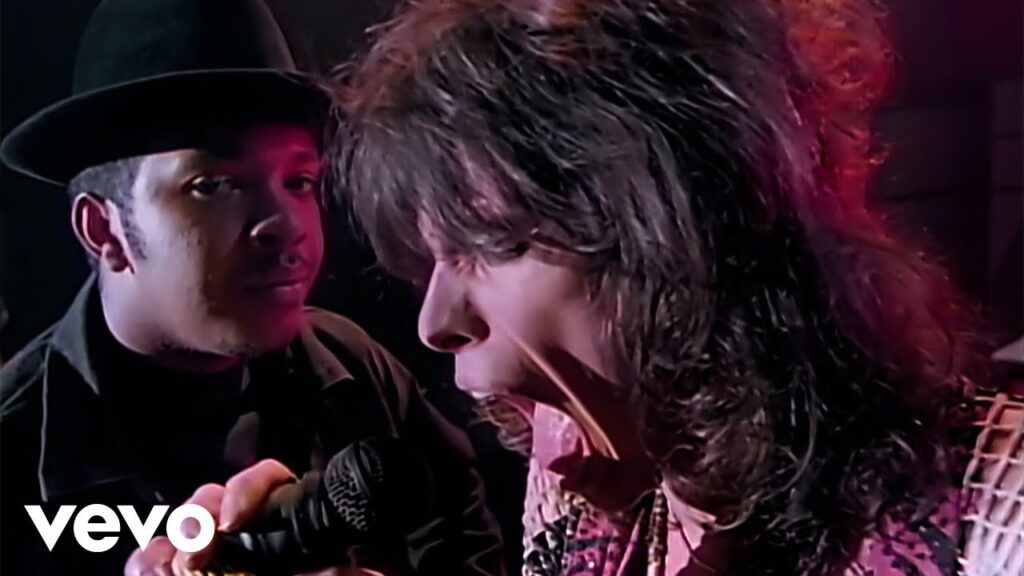
Released in July 1986, “Walk This Way” became one of the most important recordings in modern music history. Originally written and recorded by Aerosmith in 1975, the song was transformed into an electrifying collaboration between Run-D.M.C. and Aerosmith that forever changed the relationship between rock and hip-hop. Reaching No. 4 on the Billboard Hot 100, the single revived Aerosmith’s career, launched Run-D.M.C. into mainstream superstardom, and helped establish rap music as a commercial force on pop radio and MTV.
More than forty years later, “Walk This Way” remains a landmark recording whose influence extends far beyond its chart success, proving that great music can transcend genres, generations, and audiences.
A Bold Collaboration
By the mid-1980s, Run-D.M.C. had become one of hip-hop’s most innovative groups.
Joseph “Run” Simmons, Darryl “D.M.C.” McDaniels, and Jason “Jam Master Jay” Mizell had already revolutionized rap with a stripped-down, hard-hitting style that differed dramatically from the disco-influenced hip-hop of the late 1970s. At the same time, Aerosmith—once one of America’s biggest rock bands—had seen their popularity decline after years of internal struggles and changing musical tastes.
Producer Rick Rubin saw an opportunity.
Rather than simply sampling Aerosmith’s 1975 hit, he suggested that the two groups record it together.
Initially, neither side was enthusiastic.
The result would become one of the greatest collaborations in music history.
Breaking Down Musical Barriers
The new version of “Walk This Way” kept Joe Perry’s instantly recognizable guitar riff while replacing much of Steven Tyler’s original vocal with Run-D.M.C.’s energetic rap delivery.
Instead of competing against one another, the rock and hip-hop elements complemented each other perfectly. Tyler returned to sing the iconic chorus while Perry’s guitar retained the raw power that had made the original recording famous.
The collaboration felt revolutionary.
It demonstrated that rap and rock could coexist naturally rather than as separate musical worlds.
That lesson reshaped popular music.
Outstanding Performances
Run and D.M.C. attack the verses with confidence and precision.
Their rhythmic delivery gives the song an entirely new energy while preserving the playful spirit of the original. Steven Tyler’s unmistakable vocals provide the perfect contrast, soaring during the chorus with the same passion that had defined Aerosmith’s classic recording.
Joe Perry’s guitar remains one of the song’s greatest strengths.
Its opening riff is among the most recognizable in rock history and provides the perfect foundation for the rap verses.
Together, the performances create remarkable chemistry.
Rick Rubin’s Visionary Production
Producer Rick Rubin understood that simplicity would maximize the song’s impact.
Rather than overcomplicating the arrangement, he preserved the essential elements of Aerosmith’s original while giving Run-D.M.C. ample room to establish their own identity. Jam Master Jay’s scratches and the group’s rhythmic delivery blend seamlessly with Perry’s guitar and the driving rock instrumentation.
The production sounds powerful without becoming cluttered.
Its balance remains impressive even decades later.
A Major Commercial Breakthrough
“Walk This Way” became the highest-charting single of Run-D.M.C.’s career.
The song reached No. 4 on the Billboard Hot 100, introducing rap music to countless listeners who had never purchased a hip-hop record before. It also revitalized Aerosmith’s career, paving the way for the band’s enormously successful comeback during the late 1980s and early 1990s.
The collaboration benefited everyone involved.
Its commercial success demonstrated that audiences were eager to embrace musical innovation.
One of MTV’s Most Influential Videos
The music video became nearly as important as the recording itself.
Directed by Jon Small, the video begins with Run-D.M.C. rehearsing in a neighboring studio while Aerosmith performs on the other side of a wall. Frustrated by the noise, Steven Tyler famously crashes through the wall, symbolically breaking down the barrier between rock and rap before both groups perform together.
The image became one of MTV’s defining moments.
The video helped introduce hip-hop to mainstream television audiences and remains one of the network’s most iconic productions.
Why It Still Matters
The influence of “Walk This Way” cannot be overstated.
Long before genre-blending collaborations became common, this recording demonstrated that musical boundaries existed primarily in people’s minds. It encouraged artists across every genre to experiment, collaborate, and challenge expectations.
The song also remains incredibly fun.
Its infectious energy, unforgettable guitar riff, and remarkable chemistry continue to captivate listeners.
A Turning Point in Popular Music
Many songs become hits.
Only a handful permanently change the direction of music.
“Walk This Way” belongs in that rare category.
Without its success, the mainstream acceptance of hip-hop might have unfolded very differently. The collaboration opened doors that countless artists would later walk through, from rap-rock bands to modern pop collaborations spanning multiple genres.
Its historical importance continues to grow with time.
Legacy
“Walk This Way” stands as one of the most influential recordings ever made and one of the defining songs of the MTV generation. By bringing together Run-D.M.C. and Aerosmith, the collaboration broke cultural and musical barriers while introducing millions of listeners to the possibilities of genre fusion.
Its chart success, groundbreaking music video, and enormous cultural impact have secured its place among the greatest recordings in popular music history. More importantly, it proved that creativity thrives when artists are willing to ignore convention and embrace collaboration.
More than forty years after its release, “Walk This Way” remains every bit as exciting, innovative, and influential as it was in 1986. Loud, energetic, and revolutionary, it continues to stand as one of the greatest collaborations ever recorded and a milestone that forever changed the sound of modern music.
This post has already been read 78 times!