Released in May 1988 as the lead single from Reg Strikes Back, “I Don’t Wanna Go on With You Like That” marked a triumphant return to the upper reaches of the pop charts for Elton John. Combining an infectious dance-pop groove with Elton’s unmistakable piano playing and Bernie Taupin’s emotionally direct lyrics, the song proved that one of rock’s greatest legends could still compete in the rapidly changing musical landscape of the late 1980s. It became one of Elton’s biggest hits of the decade and remains one of the standout singles from his long and remarkable career.
By the late 1980s, Elton John had already spent nearly two decades as one of the world’s biggest recording artists. The 1970s had produced an astonishing run of classic albums and hit singles, including “Your Song,” “Rocket Man,” “Goodbye Yellow Brick Road,” “Bennie and the Jets,” and “Don’t Let the Sun Go Down on Me.” Although the early 1980s brought continued success with songs like “I’m Still Standing,” “Sad Songs (Say So Much),” and “Nikita,” musical tastes were changing rapidly. Synth-pop, dance music, and polished studio production dominated radio, and many veteran artists struggled to adapt.
Elton John, however, had never been afraid to evolve.
“I Don’t Wanna Go on With You Like That” showcased an artist who understood contemporary production while remaining true to his musical identity. Rather than abandoning his signature piano style, Elton integrated it into an energetic dance-oriented arrangement that sounded perfectly at home alongside the biggest pop hits of 1988.
As always, the lyrics came from Bernie Taupin, Elton’s longtime songwriting partner. Taupin tells the story of someone trapped in an unhealthy relationship, finally reaching the point where enough is enough. Instead of pleading for reconciliation, the narrator chooses self-respect and independence. The emotional honesty of the lyrics gives the song weight beneath its upbeat musical surface, creating a satisfying contrast between its infectious rhythm and its message of personal liberation.
The recording begins with bright synthesizers and a driving beat before Elton’s piano enters the mix. Even surrounded by modern electronic production, his piano remains the song’s emotional anchor. His energetic playing adds warmth and authenticity, reminding listeners why he has long been considered one of rock’s finest pianists.
Elton’s vocal performance is equally impressive. By this point in his career, his voice had developed a slightly rougher texture than during the 1970s, giving his performances added character and emotional depth. On “I Don’t Wanna Go on With You Like That,” he sings with confidence and determination, perfectly capturing the frustration and resolve expressed in Taupin’s lyrics.
Producer Chris Thomas deserves considerable credit for the recording’s polished sound. Having worked extensively with Elton during the 1980s, Thomas understood how to modernize the singer’s music without sacrificing its core strengths. The arrangement combines crisp drum programming, layered synthesizers, rhythm guitars, and Elton’s piano into a seamless production that remains surprisingly fresh decades later.
The chorus is one of the song’s greatest assets. Built around an instantly memorable melodic hook, it delivers exactly the emotional payoff listeners hope for after the tension established during the verses. It’s catchy without feeling repetitive, making it easy to understand why the song became such a radio favorite.
Commercially, the single became one of Elton John’s biggest successes of the 1980s. It reached No. 2 on the Billboard Hot 100 in the United States, narrowly missing the top spot, and became a Top 10 hit in several other countries. It also performed exceptionally well on adult contemporary and dance charts, demonstrating its broad appeal across multiple audiences.
The success of “I Don’t Wanna Go on With You Like That” helped propel Reg Strikes Back to platinum status and reaffirmed Elton’s ability to remain commercially relevant nearly twenty years into his recording career. At a time when many of his contemporaries were seeing their popularity decline, Elton continued to produce genuine hit records.
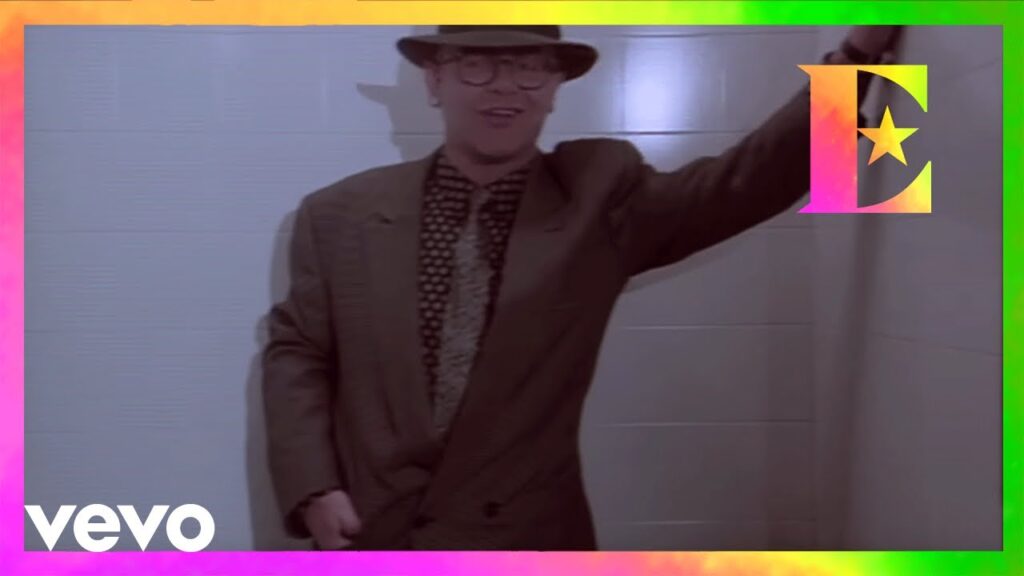
The accompanying music video reflected the colorful visual style of the late 1980s, featuring Elton performing amid vibrant lighting and dynamic staging. While not as elaborate as some of the era’s biggest MTV productions, it showcased his charisma and reinforced the upbeat energy of the song.
Looking back, one of the most impressive aspects of “I Don’t Wanna Go on With You Like That” is how successfully it bridges different eras of Elton John’s career. The melody, piano playing, and songwriting partnership with Bernie Taupin are unmistakably classic Elton, while the production embraces contemporary sounds without feeling forced or artificial.
The song also highlights Elton’s remarkable adaptability. Throughout his career, he successfully navigated changing musical trends—from glam rock and singer-songwriter ballads to disco, new wave, and dance-pop—while always sounding unmistakably like himself. Few artists have managed such consistent reinvention without losing their identity.
Today, “I Don’t Wanna Go on With You Like That” remains a favorite on classic hits and adult contemporary radio. Although it sometimes receives less attention than Elton’s legendary 1970s catalog, fans recognize it as one of his strongest later-career recordings. It also remains a highlight of compilations celebrating his remarkable career and occasionally appears in his live performances.
More than thirty-five years after its release, “I Don’t Wanna Go on With You Like That” stands as one of Elton John’s finest 1980s recordings. Its irresistible groove, polished production, memorable chorus, heartfelt lyrics, and Elton’s spirited performance combine to create a song that still feels vibrant today. It serves as a reminder that true musical greatness isn’t simply about achieving success once—it’s about continuing to evolve while staying true to the qualities that made you unforgettable in the first place.
This post has already been read 86 times!