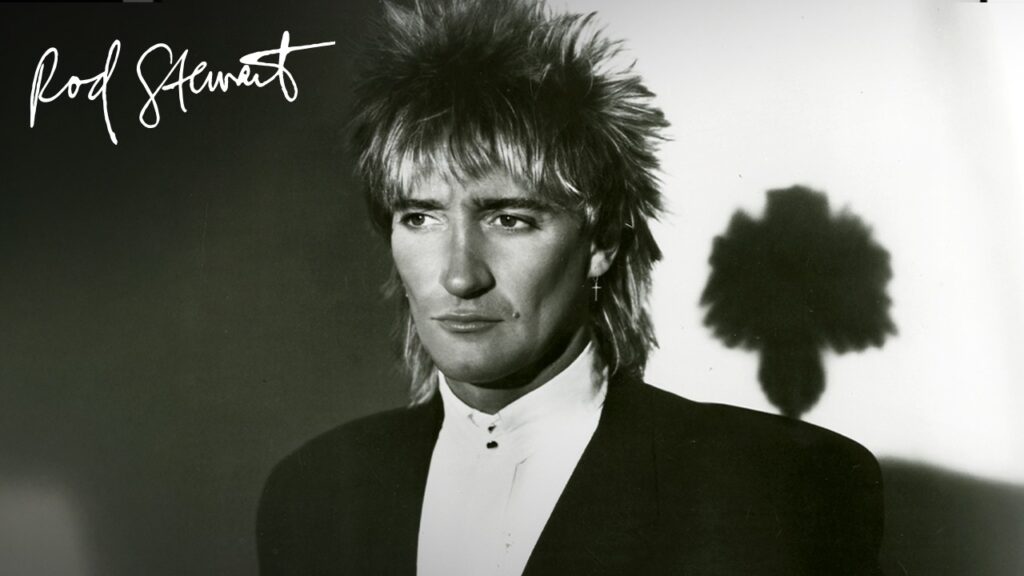
Released in October 1981, “Young Turks” represented one of the boldest reinventions of Rod Stewart’s remarkable career. Already a superstar thanks to his work with the Jeff Beck Group, Faces, and a string of successful solo albums, Stewart had spent the 1970s establishing himself as one of rock’s premier voices with hits like “Maggie May,” “Tonight’s the Night,” and “Da Ya Think I’m Sexy?” Rather than relying solely on the blues-rock style that first made him famous, Stewart embraced the emerging sounds of synthesizers and new wave, creating one of the defining pop-rock singles of the early 1980s.
The song appeared on Stewart’s album Tonight I’m Yours, an album that deliberately mixed traditional rock with modern production techniques. Many veteran rock artists struggled to adapt as musical tastes changed at the beginning of the decade, but Stewart showed an impressive willingness to evolve. Instead of chasing trends blindly, he incorporated contemporary elements while preserving the raspy, unmistakable voice that had always been his greatest strength.
Interestingly, despite its title, the phrase “Young Turks” has nothing to do with the political movement that inspired the expression decades earlier. In English, “young turks” had long become a common phrase describing rebellious, independent-minded young people who challenged convention. Stewart used the term to tell the story of two teenagers determined to build a life together despite overwhelming obstacles.
The song centers around Billy and Patti, a young couple who decide to leave home in pursuit of freedom and a better future. Faced with disapproving parents, financial hardship, and an unexpected pregnancy, they refuse to abandon their dreams. Rather than presenting an idealized fairy tale, Stewart acknowledges that life will be difficult, but he celebrates their courage and determination to face adulthood on their own terms.
That narrative approach helped distinguish “Young Turks” from many pop songs of the era. Instead of focusing solely on romance, it tells a complete story filled with relatable characters and genuine emotional stakes. Listeners become invested in Billy and Patti’s journey, making the song feel almost cinematic.
Musically, “Young Turks” marked a significant departure from Stewart’s earlier work. The recording is driven by a propulsive electronic rhythm inspired by the synth-pop and new wave movements sweeping across Europe and America. Producer Tom Dowd and Stewart blended drum machines, synthesizers, driving bass, and crisp guitars into a polished yet energetic arrangement that sounded completely contemporary in 1981.
One of the most recognizable elements is the song’s pulsing synthesizer riff. Rather than simply decorating the arrangement, the keyboard line serves as its heartbeat, providing constant momentum from beginning to end. Combined with the driving rhythm section, it creates an irresistible sense of forward motion that mirrors the story’s themes of escape and possibility.
Rod Stewart delivers an outstanding vocal performance. His gravelly voice had always carried tremendous personality, and here it provides the perfect contrast to the sleek electronic production. Stewart sounds both compassionate and encouraging as he tells Billy and Patti’s story, bringing warmth and humanity to an otherwise modern-sounding arrangement.
The chorus is one of Stewart’s strongest. It is instantly memorable, emotionally uplifting, and perfectly captures the song’s central message about taking risks and believing in yourself. Decades after its release, audiences still enthusiastically sing along whenever Stewart performs it live.
Commercially, “Young Turks” became another major success. It reached No. 5 on the Billboard Hot 100 in the United States and climbed into the Top 20 in the United Kingdom while performing well throughout Europe, Canada, and Australia. The hit helped introduce Stewart to younger audiences who were embracing MTV and the rapidly changing musical landscape.
The music video also played an important role in the song’s popularity. Rather than featuring Stewart throughout, the video focuses largely on breakdancers—a style of dance that was still unfamiliar to many mainstream audiences in 1981. It became one of the earliest major music videos to feature breakdancing prominently, exposing millions of viewers to a cultural movement that would soon become a worldwide phenomenon. In hindsight, the video was remarkably forward-thinking and helped demonstrate MTV’s growing influence on popular culture.
Looking back, “Young Turks” stands as one of Stewart’s most successful reinventions. Some longtime fans were initially surprised by its electronic production, but time has been kind to the recording. The combination of storytelling, memorable melodies, and polished production has allowed it to age remarkably well.
The song also highlights Stewart’s underrated versatility. While often remembered primarily as a rock singer with a raspy voice, his willingness to explore soul, disco, pop, folk, and new wave throughout his career kept his music fresh. “Young Turks” perfectly illustrates that artistic curiosity, proving he could adapt to changing musical landscapes without sacrificing his identity.
Today, the song remains one of the highlights of Rod Stewart’s live concerts and a staple of classic hits and 1980s radio stations. Its themes of youthful optimism, independence, and perseverance continue to resonate with listeners of all ages. New generations regularly discover the song through streaming services, movie soundtracks, and nostalgic playlists celebrating the music of the early MTV era.
More than forty years after its release, “Young Turks” remains one of Rod Stewart’s finest achievements. Its compelling story, unforgettable chorus, innovative production, and passionate vocal performance transformed what could have been a simple pop single into a timeless anthem about chasing dreams despite uncertain odds. It stands as proof that great artists are willing to evolve, take chances, and embrace change while remaining true to the qualities that made them successful in the first place.
This post has already been read 79 times!